


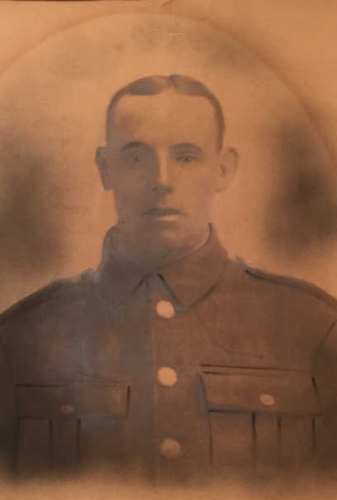
George's Story.
George was the second child of William and Emily Yates, born at Forge Fields Wheelock Cheshire in 1893. He had three sisters, Celia his older sister then Annie & Lillie.
As a youngster growing up in Wheelock he attended the Wheelock Wesleyan School and joined the boys brigade, then when old enough he enlisted into the Cheshire regiment 7th Battalion. The 7th Battalion, Cheshire Regiment was a Territorial unit with their HQ based in Macclesfield. George was in G coy, this was the Sandbach, Middlewich and Winsford company, we are not sure when he joined the TA but we do know that he was awarded the Territorial Force War Medal which means he would need to have been serving with the force on 4 August 1914 or have completed four years’ service with the force before 4 August 1914 and rejoined the force on or before 30 September 1914.
George had previously worked as a cow hand in Betchton Sandbach then Fodens based in Elworth. When war was declared on Germany in August 1914, it is believed that George was helping his farther William to dig out the footings for the Drill Hall in Sandbach. We have no record of what camp George was based in the UK before being sent to France. From Family history, it is known that he sent his mother a postcard/letter informing her of how he had won a shooting competition and was apparently very pleased with himself and who could blame him.
George was at some time transferred to the Manchester Regiment 21st (6th City) Btn, this was one of the many Pals regiments. At this time, we cannot locate any documentation regarding George joining the 21’st it is possible that he was already with them before being sent to France. George landed in France on the 31st of August 1916, the regiment received reinforcements on the 5th September that year, it is more than likely that George would have been one of them.
The 21st Manchester’s at the time had just arrived in Becordel-Becourt (the Somme) on the same day. George’s first action would have possible been at the Battle of Delville Wood, one of the many engagements that took place during the Somme.
The regiment also took part in the Battle of Guillemont and operations on the Ancre. The retreat to the Hindenburg line, the Arrass offensive. Then moved on to Flanders and the third battle of Ypres also known as Passchendaele, seeing action in the Battle of Polygon Wood, the Battle of Broodseinde, the Battle of Poelcapelle and the Second Battle of Passchendaele.
In late 1917 George and the Battalion were moved to Italy. He would have been in the Battle of River Paiave. Then returned to France September 1918.
In 52 days George would became another casualty, he was killed on the 4th of November 1918 with only 7 days of fighting left until the end of the Great War. George fell while fighting in the Battles of the Hindenburg Line, possible in the Ponchaux region, Guisancourt Farm.
A few years after the war, George’s farther William while leaving his place of work was greeted by a young gentleman who was waiting for him outside, we do not at this time know more about him other than he informed William that he was a friend of George and was behind him when he fell, he went on to say that he could not see any marks on him, this will always be a mystery to the family, maybe his mate did not turn him over, in battle there would not be time to spare, the story does however state that he did in fact look him over but we will never know for sure.
His mother Emily never really got over her loss, she was convinced he was still alive, sadly this was not the case.
His body was not found as far as we know, maybe he was later hit with a shell no one can tell, he is remembered at Vis-En-Artois Memorial France.