


George William's Story.
George William Linekar was born in January 1882 to parents, Miles, a joiner and Jane. In 1891 they lived in Thomas Street, Little Meols. George, aged 9, was at school. His father was a widower as George’s mother had died the previous year. Also in the household were George’s three sisters and a brother.By 1901 the family resided at 11 Cable Road in Hoylake. George’s occupation on the census that year was joiner, the same as his father.
The 1911 census showed that the family still lived at 11 Cable Road but the head of the household was now George’s sister Ann. His father Miles still lived there but was retired.
In 1915, with the First World War already into its second year George enlisted in the Royal Engineers, and following training was engaged in work on the East Coast defences. In January 1917 he was transferred to the 1/9th Battalion, King’s Liverpool Regiment (KLR). He arrived in France soon afterwards.
From the end of July 1917, the 1/9th KLR were involved in the Battle of Passchendaele (Third Battle of Ypres) fighting around the St. Julien area in Belgium. Following that engagement they were moved to Lempire in Northern France. In November 1917 George along with his unit were engaged in the Battle of Cambrai. On the 2nd December the battalion were ordered to take over the line from the 6th Battalion KLR who occupied trenches at the northern end of Catelet Valley. During the day there were a couple of heavy barrages from the Germans directed at the areas occupied by the battalion. At some stage on that day George Linekar was killed.
Private George William Linekar was buried in Villers-Faucon Communal Cemetery Extension, France.
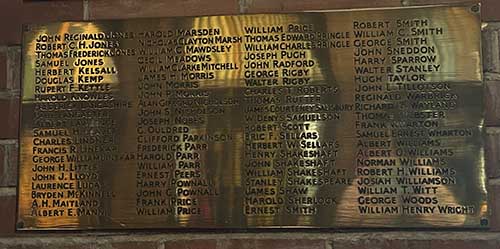
As well as the West Kirby War Memorial George is also remembered on the Men of Hoylake War Memorial in St. Hildeburgh’s Church.
George Linekar's name on te WW1 War Memorial in St. Hildeburgh's Church, Hoylake.
Research by Chris Booth