


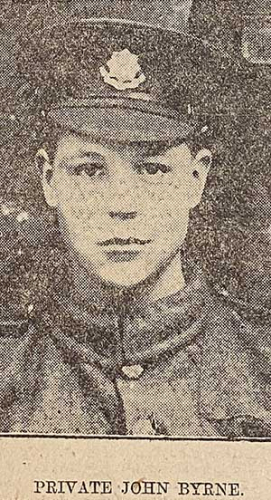
John's Story.
John Byrne was born in Birkenhead on the 28th August 1897 to parents Michael, a dock labourer, and Catherine Byrne (nee’ Byrne). He was baptised a week later on the 5th September 1897 at St. Laurence’s Roman Catholic Church.In 1901 the family lived at 183, St. Anne Street, Birkenhead. The census of that year records that John had two brothers and two sisters.
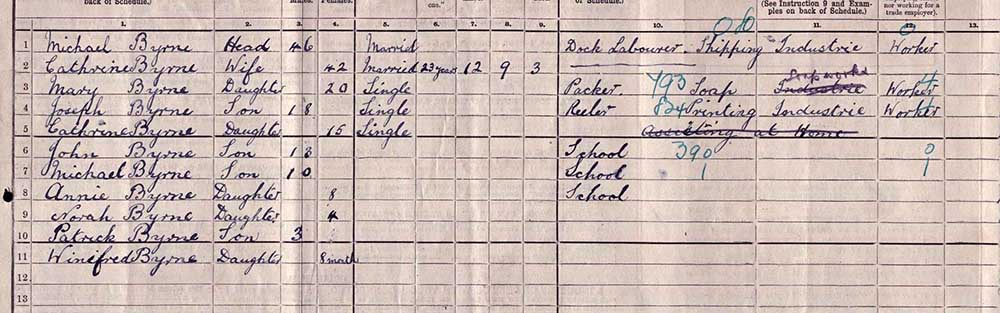
By 1911 the family had moved to 1, Kinmel Street in Birkenhead. The following extract from the 1911 census shows that John was still at school. By then he had another three sisters and a brother. Three other siblings had died in infancy.
Following the outbreak of the First World War John enlisted in the Army and was posted to the 4th Battalion Cheshire Regiment. On the 8th August 1915 John and the rest of his battalion landed at Suvla Bay, Gallipoli.
Four weeks later, on 4th September, an article in the local newspaper, the Birkenhead News, reported a letter from John to his parents
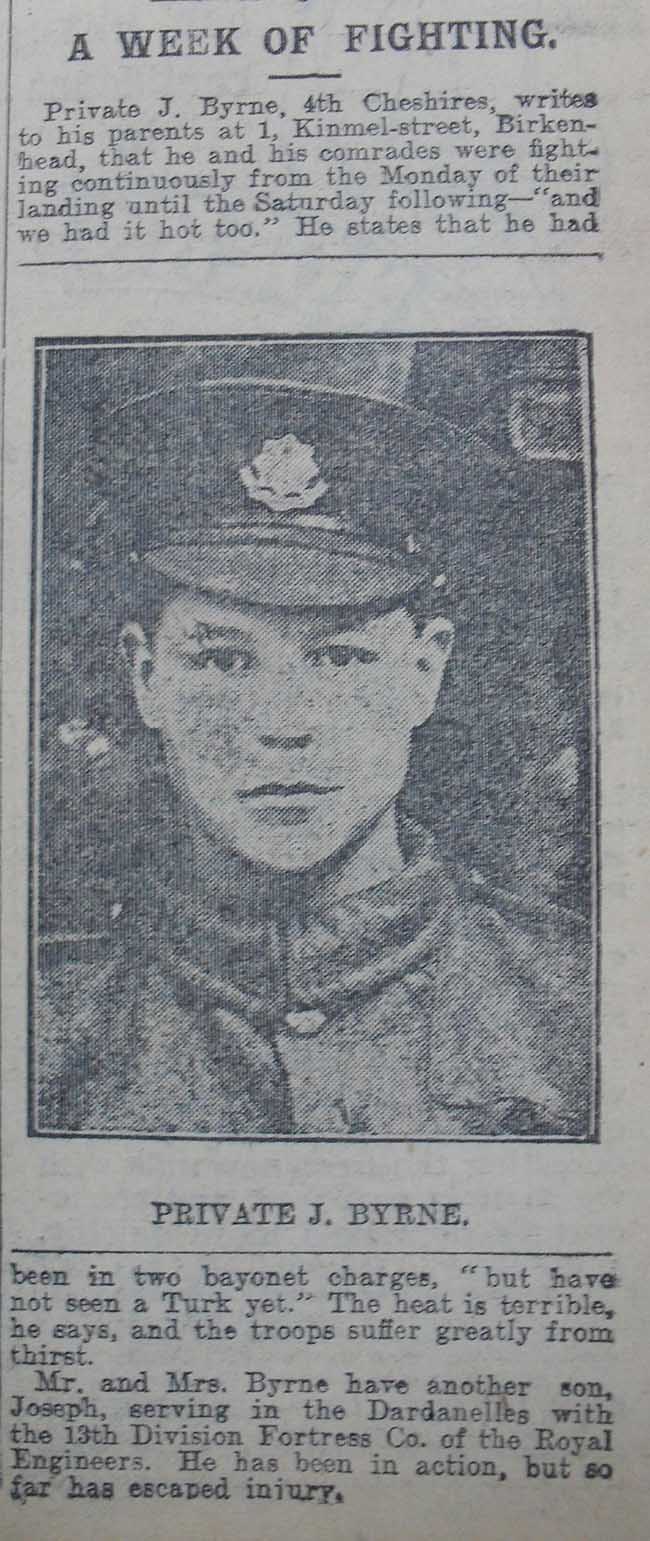
Sadly, a fortnight after the article was published Private John Byrne, aged just 18 years, was killed in action. He is buried in Azmak Cemetery, Suvla. He was entitled to 1914/5 Star, the British medal and Victory medal.
Birkenhead News 13 October 1915
Former Port Sunlight Employee.
KILLED IN THE DARDANELLES.
Information has just been received by Mr. and Mrs. Byrne, of 1, Kinmel Street, that their son Private John Byrne, who has been serving with his regiment, the 4th Cheshires, for some few months at the Dardanelles, was killed in action on September 15th. A short while ago we published a letter from Private Byrne, written from the front, in which he said he had been in two bayonet charges, but had “not seen a Turk.” Prior to the war he worked at Messrs. Lever Bros., Port Sunlight, and before that again was in private service with an Oxton gentleman.
Mr. and Mrs. Byrne have another son, Joseph, serving in the Dardanelles with the 13th Division Fortress Company of the Royal Engineers. He has been in action but so far escaped injury.
John’s brother, Joseph, served in the First World War with the Royal Engineers, also in the Dardanelles. He survived the war.
Research John Byrne’s photograph and newspaper article by Chris Booth.