


George's Story.
Born in Liverpool in 1877, son of Samuel Arnold who worked as a porter. 17th October 1898 George married Augustina Mounsey, in 1901 the family were living in the Great Crosby area of Liverpool and they had one son, George Mounsey Arnold.
By 1911 the family had moved to Wallasey and were living at 23 Geneva Road Seacombe, George was working as a General Labourer, the couple had six children of which two had sadly died. The surviving children were, George Mounsey 10, Ivy 7, Thomas 4 and Angus McCrae 6 months, also living with them was Augustina’s father Joseph. Another child was born before 1916.
George enlisted in December 1914 at the time he was employed at Simpson and Roberts canned goods merchants, Barton Street, Liverpool, after nine months of training on the 25th September 1915 George and the 11th battalion Cheshire Regiment embarked from Southampton, arriving at Le Havre 7am the following morning. 
Within days the battalion moved into the line near to Ploegsteert Wood. On the 2nd October the battalion suffered its first casualty, Private William Swann from Stockport serving with "B" Company was shot in the head by a sniper. The battalion stayed in the Ploegsteert area until the end of January 1916. In February they were in Strazeele, on the 9th they were inspected on a route march by the commander of the 2nd Army Commander General Sir Hebert Plumer on the Strazeele -Feltre road. The battalion would spend the next few months near to Vimy, at Ecoivres and by June they were on the Somme.
During the night June 30/July 1st the battalion marched about 9 miles from Toutencourt to Hedauville, the Battle of Somme had commenced. The battalion stored its kit in the village and were held in readiness to move at an hour’s notice. At 9:30am on the morning of the 2nd July orders were received for the battalion to move to Martinsart Wood, this was carried out without difficulty and the battalion bivouacked alongside the wood. At 5pm orders were received from Brigade HQ to issue each man in the battalion with two Mills Bombs and to issue as many picks and shovels that could possibly be carried, they were also given an extra 50 rounds of ammunition. At 11pm orders were received to move into the attack, moving up via Black Horse Bridge the battalion HQ was established at Campbell Post just off Campbell Avenue.
At 6:20 3rd July the battalion were in position and went into the attack, the battalion war diary for the day states:
3rd July 1916.
On immediately visiting the companies the adjutant found that a considerable number of casualties had occurred during entrance to the assembly positions, that the British trenches were devoid of British troops and that the guides had no instructions other than to lead the companies to some particular spot in the trenches. How much of the trench each company was to occupy was left to the imagination, no further relief of troops in fact had taken place. By about 5:30 am the companies had more or less taken up some portion of the trenches and got in touch with me. The trenches were exceedingly badly knocked about, affording little cover from fire and in a great many places little cover from view. Steps were taken to organise the bombers and to account where the dumps were to ensure a supply of bombs to the companies. At about 6:20 am the Border Regt. on the left of the battalion (with whom touch had been made) attacked the German positions but by whose orders is not known. The right flank of the Borders being enforced, the leading companies of the Cheshire’s immediately attacked, and the assaulting waves passed over No MAN’S LAND in perfect order. Word to this effect was immediately sent to the Commanding Officer who at once proceeded to the scene of action. The assaulting troops very soon came under a withering fire from machine guns, which made the ground at about 50 yards from the first German line absolutely impassable, line after line of the troops were mown down. The commanding officer who went with the reserve company was unfortunately killed and Captain Hill, the adjutant on whom the command of the Battalion devolved decided to get the men still living back into the trench from which they jumped off and to hold it as a defensive line. The remainder of the day was spent in trench warfare and carrying up wounded and other casualties. Unfortunately, the list of casualties was large and included every Company Commander. 20 Officers and 657 Other Ranks entered the trenches on the 3rd and of that number, 6 Officers and 350 Other Ranks came out on the night of the 4th.
On the night of the 3rd the battalion under orders from Brigade moved further North by about 300 yards and held another section from STAFFA ST. to TYNDRUM ST. linking up with the 8th Border Regiment, the place of the 11th Cheshire’s being filled by the 1st Wiltshire Regt. During the night of 3rd- 4th the section of the trench held by the battalion was heavily shelled. On the afternoon of the 4th the Cheshire’s were relieved by the 1st Wiltshire Regt.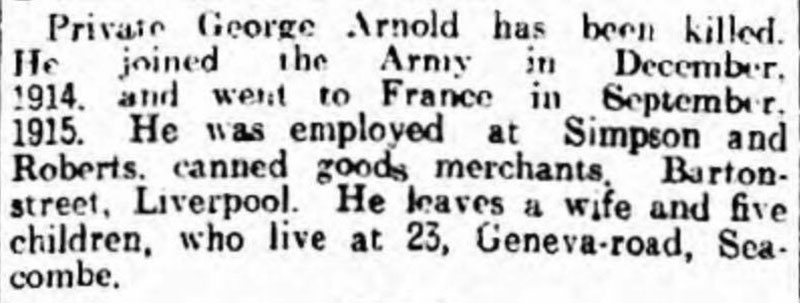
It was during this attack that George was killed, if his body was found and buried its location was lost during the following years of fighting, and so he is named on Thiepval Memorial just a short distance away from where he fell.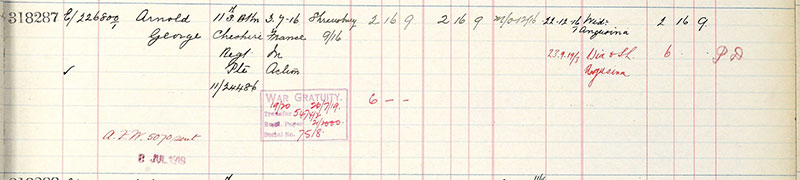
In July 1919 Augustina received £6 war gratuity.
The Cheshire Roll of Honour would like to thank Jorge Arnold for the picture of George and newspaper cutting.