


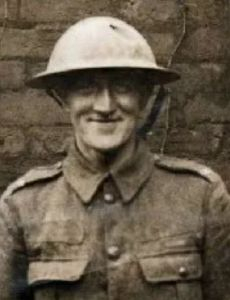
Thomas Alfred's Story.
Private Thomas Alfred Jones, (1880 - 1956) known to his friends and colleagues as Todger Jones, served in the Cheshire Regiment during the Great War, and was a recipient of the Victoria Cross and the Distinguished Conduct Medal. He returned from WW1, and lived in Runcorn until the age of 75. This is his story ....
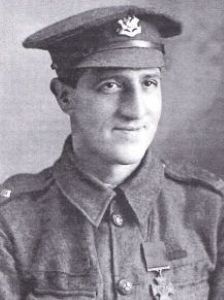
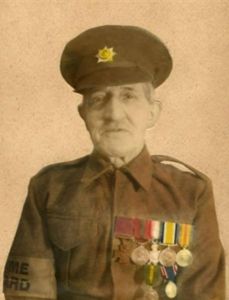
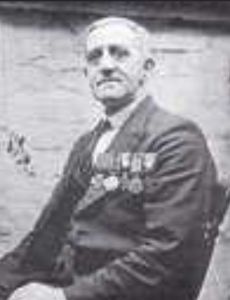
Thomas Alfred Jones was born on Christmas Day 1880, the son of Edward Jones (1842–1932) and Elizabeth Lawson (1848–1927). The family home was at 39 Princess Street, Runcorn, where Thomas grew up with his seven siblings: Joseph Edward (1869–1923), Emily (1870–1956), Frederick (1873–1925), Peter (1875–1926), Charles Arthur (1884–1917), (Sarah) Maude (1887– 1959) and Walter (1891–1937). Another sister, Lily (1888 – 1889) had died in infancy. Thomas was to be the longest-lived of all the boys, as none of the other brothers reached the age of 55. Read the story of his brother Charles who died in 1917.
Occupations
His father was a fitter at the Hazlehurst Soap Works, Runcorn, where he worked for 62 years. The family was Wesleyan, and Edward was also a preacher at the Ellesmere Street Free Church in Runcorn. Thomas was educated at Runcorn National School from 1885-1894, and started work as an apprentice fitter at the same firm that his father worked in. He later became an engineering fitter at the Salt Union Works at Weston Point, Runcorn, and returned to this occupation in 1919 after the war.
How did Thomas get the nickname Todger?
At school, he excelled at football and earned the name Dodger, which combined with his first initial eventually turned into Todger.
Enlistment
At the age of 19, Thomas first enlisted with the Runcorn Volunteers on 15th January 1900, a company of 2nd (Earl of Chester’s) Volunteer Battalion. It became 5th (Earl of Chester’s) Battalion, The Cheshire Regiment on 24th April 1908 on the formation of the Territorial Force. He was noted for his marksmanship and was awarded the Territorial Force Efficiency Medal in 1912. When he resigned from the Territorial Force in 1913, he went on to the National Reserve.
Family life
Thomas did not ever marry. He and Robina Abram (1895 – 1962) had a son, Thomas William Jones Abram, born on 8th April 1915, while Thomas was away in France with his regiment. In 1918, Robina married Joseph Griffiths (895–1962) and had a daughter Marjorie (1936 - ). Thomas Abram (1915 – 1986) was brought up as Joseph's stepson. He married Minnie Nash in 1939, and Thomas Alfred Jones became grandfather to Edna Abram (1941–1996) and Lynda (1947 - ).
The Great War 1914 - 1918
Thomas was recalled on 5th August 1914 and was attested at Runcorn on 31st August 1914. He would have liked to go into the Royal Engineers, but remained with the Cheshire Regiment. After training at Birkenhead, he was sent to France on 16th January 1915. He did not see his newly born son, Thomas William Jones Abram (1915 – 1986) until December that year by which time the baby was eight months old. On Christmas Eve 1915, he was punished for overstaying his leave in England by four days, forfeiting four days’ pay. One account records that his lateness in returning was due to his being treated for shell-shock, rather than deliberate absence without leave.
1916 - awarded the Victoria Cross, the highest award for gallantry in the face of the enemy awarded to British and Commonwealth forces.
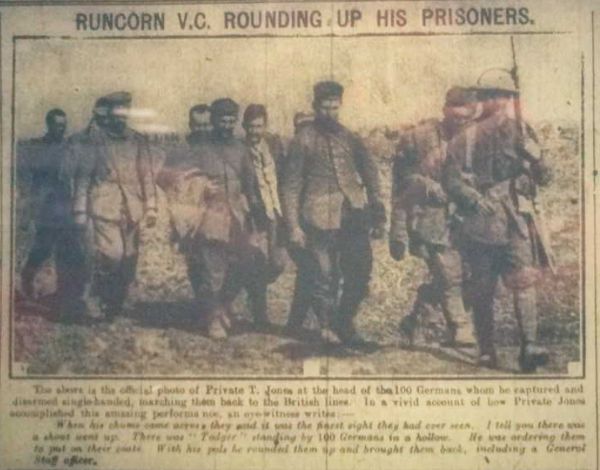
"Looking back and thinking over the incident, I feel that I must have had what the poets call “a charmed life,” for, after jumping out of the trench and before I had accounted for the sniper in the tree, a bullet went through my helmet and was buzzing round my head-piece like a marble in a basis, finally galloping down my back and burning me during the journey. Four or five other bullets passed through my tunic, but I wasn’t aware of it until afterwards. It never entered my mind that I should be killed, and I didn’t think my time had come."
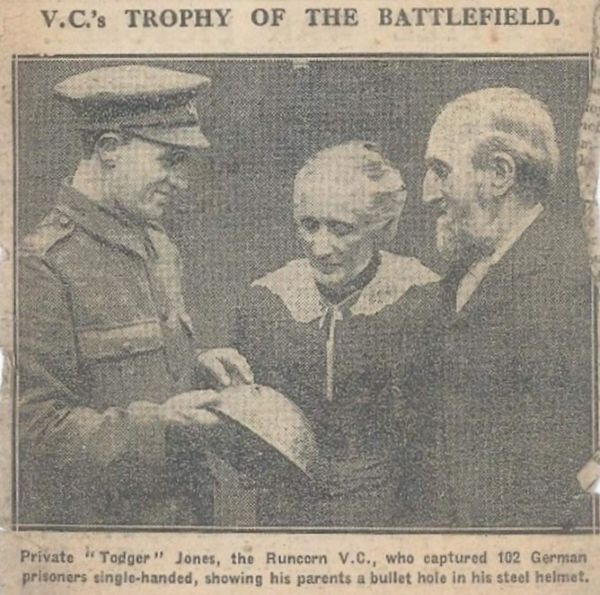
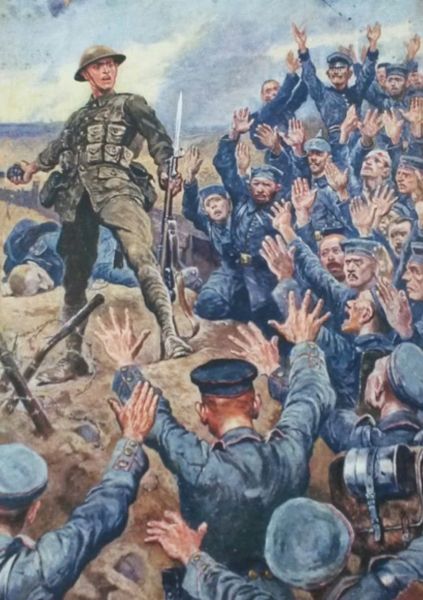
On 25th September 1916, during the Battle of Morval, Private Jones performed an act of bravery for which he was awarded the Victoria Cross. He was with his company covering the advance in front of a village, when he noticed an enemy sniper 200 yards (183 m) away. He left his trench on his own, and crossed no man’s land without any covering fire. Although one bullet went through his helmet and another through his coat, he returned the sniper’s fire and killed him. Near the enemy trench, he saw two more Germans firing on him while simultaneously displaying a white flag. Jones shot them both. Upon reaching the enemy trench, he found several occupied dugouts and single-handedly disarmed 102 Germans, and took them as prisoners of war. Three or four were officers, and the entire trench was taken by Private Jones and his comrades. The photograph below depicts him showing his damaged helmet to his parents.
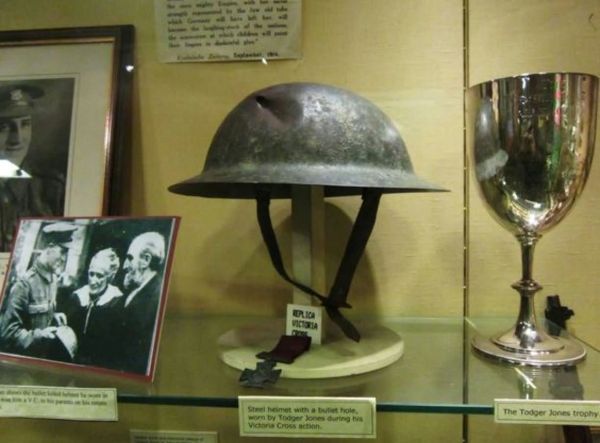
The helmet is now on display at the Cheshire Regiment Museum in Chester.
The VC was presented by King George V at Buckingham Palace on 18th November 1916. The king asked him about his actions. Thomas’s account, in his own words, appears at the end of this page.
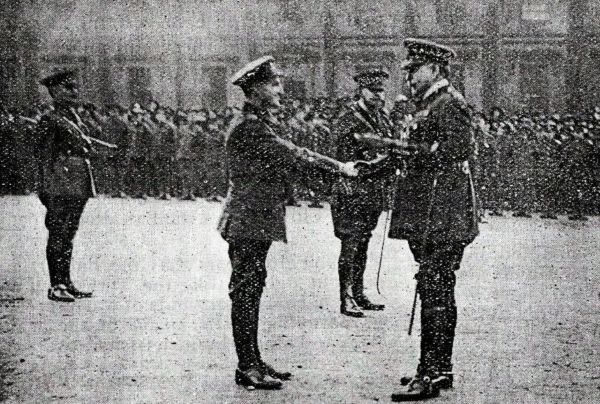
“How the dickens did you do it, Jones?” asked King George, as he invested Private Jones with the Victoria Cross
He received a civic reception in Chester and was presented with a gold wristwatch, a silver teapot, a case of cutlery and a pair of field glasses. He was given a hero’s welcome in his home town of Runcorn.
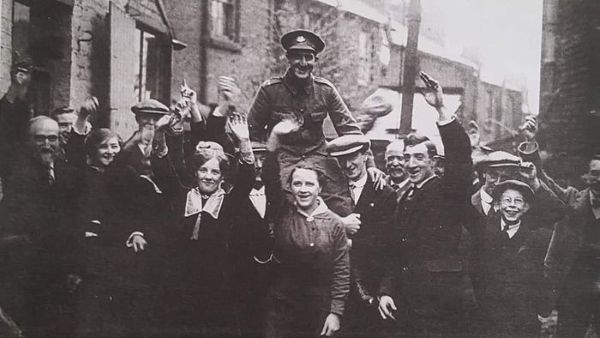
1917 Death of his brother Charles Arthur Jones
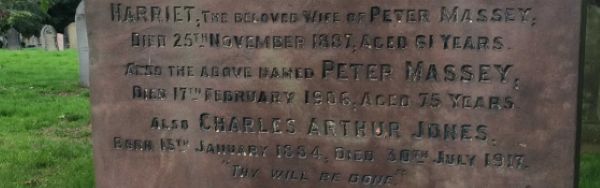
Thomas’s younger brother Charles Arthur Jones (1884–1917) of the 10th Battalion Cheshire Regiment died on 30th July 1917. He was 33 years old. His story is here.

1918 Distinguished Conduct Medal
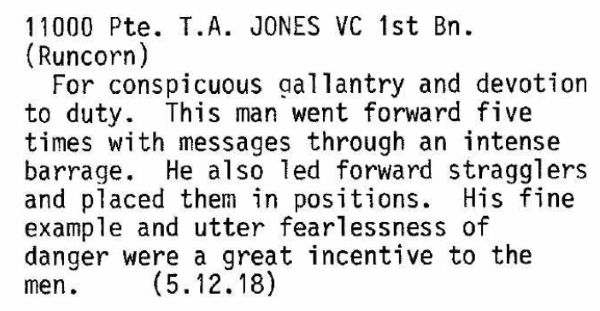
Thomas was wounded and gassed on 4th August 1918 and admitted to hospital at St Omer the following day. Six weeks later, he was awarded the DCM for his actions at Beugny near Bapaume on 28th September 1918. The citation records that he went forward five times with messages through an intense artillery barrage. He also led forward stragglers to their positions.
Post war
Private Jones was discharged on 28th May 1919. Thomas returned to his pre-war job at the Salt Union Works, which was later taken over by ICI. He remained there for the next 30 years, until retirement in 1949.
During the Second World War, he was an ARP Warden and later served in the Home Guard. He was a member of the Liberal Club in Runcorn, winning prizes for billiards, and he also served as Honorary Secretary of Runcorn Reserves Football Club. At the end of his life, he was still living at 39 Princess Street, Runcorn, the house where he had been born.
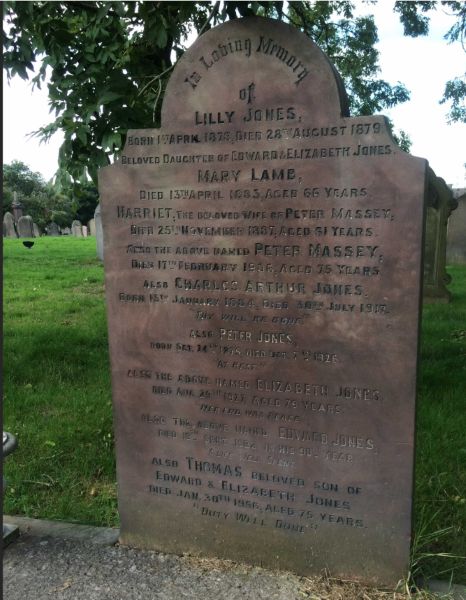
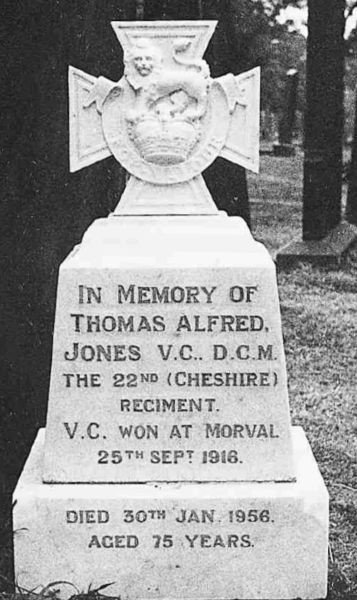
Thomas was admitted to Victoria Memorial Hospital, Runcorn on 4th January 1956, and died there on 30th January. He was 75 years old. The causes of death were pulmonary embolism, auricular fibrillation and arteriosclerosis. He was buried in Runcorn Cemetery, his name inscribed on the family headstone, along with that of his brother Charles.

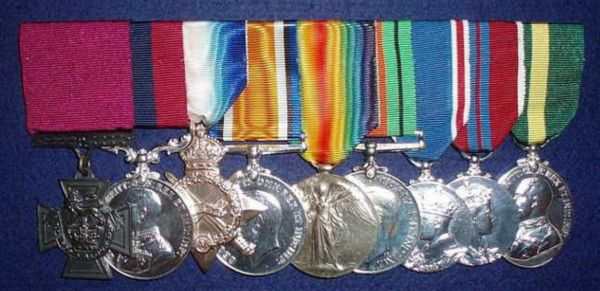
In addition to his VC and DCM, Thomas was awarded the 1914-15 Star, British War Medal 1914-20, Victory Medal 1914-19, Defence Medal 1939-45, Territorial Force Efficiency Medal, George VI Coronation Medal 1937 and Elizabeth II Coronation Medal 1953.
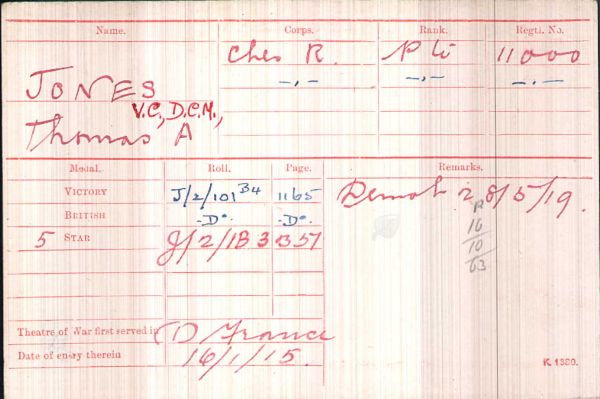
On 16th May 1956, his sister, Emily Lightfoot, donated the medals to the Cheshire Regiment Museum. The museum also displays the helmet that he wore in 1916, with the hole from a bullet.

PRIVATE "TODGER" JONES V.C. D.C.M TELLS HIS OWN STORY OF HOW HE CAPTURED 102 GERMANS
“How the dickens did you do it, Jones?” asked King George, when he invested Private Jones with the well-earned Victoria Cross. Here is the answer - “Todger’s” own modest account of his amazing feat. It is a story that will live. A record of dauntless pluck and unfailing cheerfulness in the face of death worthy of the glorious annals of the Victoria Cross. “If I’ve got to be killed, I’ll die fighting, not digging.” It was with these words on his lips that Private “Todger” Jones leaped from the British trenches. “Surely” said he, when approached afterwards, “there has been ‘nuff said, more than enough of a thing that was done on the spur of the moment by a man who kept his head and knew how to use his gun. But if you want to know what I did, let the official account speak for me”. “If that won’t fill the bill,” observed Jones, “I will tell you the story.” It was on September 25th that we took a village and were just beginning to dig ourselves in near the wood when bullets commenced to whiz past us, wounding one of our men in the head and making things decidedly uncomfortable. I felt the bullets ping-pinging by me and I said to the officer, “they’re going to make it hot for us, Sir, if we don’t get after ‘em. Can I get out and have a packet at them?” “My orders are to consolidate this position,” replied the officer. “You must not go an inch farther, and you had better get on with your digging.” And dig I did, but as I got up again I saw a chap hit through the head and another through the thigh. Looking ahead, I saw what appeared to be a white flag, and that fairly riled me. My “dander” was up and I shouted to the officer, “What do you think of that, Sir?” “You must get on with your digging, Jones” said he; but up I jumped and called out, “If I’ve got to be killed, I’ll die fighting, not digging.”
I waited no longer, but dragged out my rifle, flung down my entrenching tool, jumped out of the trench and went across. The Huns were a couple of hundred yards away and they could see me coming. One bullet went “sss” through my steel helmet and four more through my jacket. There was a sniper in a tree but I soon counted him out. On I went and reached a “bay”, or traverse, leading to the German trench. There were three men in it, but jumping in at the end of the trench, I had only one at a time to deal with. I got my back to the wall, and they whipped round on me. I always believe in firing from the hip and very quickly number one dropped dead. Before the next man could recover his senses, I had shot him as well, slipped another cartridge in the breech and got the old magazine going on the third at a yard range. The other man fired at me from the entrance to the dugouts, but I managed to “get there” first every time, which is a great thing in jobs of that kind.
In the second traverse there were five chaps standing behind one another. One of them made for me with his bayonet, but I bowled him over like the others by the old trick of shooting from the hip. I got the five of them. I stalked through the trench, storming and shouting and hearing the firing and the commotion, the rest of the crowd bolted in the dugouts. Soon they had all gone to earth and I was there alone. When they got into their dugouts I had them. They were shouting and screeching, and every time I saw a movement I let fly. Eventually they quieted down and seeing some of their bombs, a pile of them, on the floor of the trench, I picked up a couple and sent them flying down the first dugout and they went off all right. I think they felt that the game was up when the bombs began to drop amongst them, for out rushed three fine specimens with their hands up and the usual cry - “Mercy, Kamarad!” They had left equipment behind them to show there was no “monkeying” and though I felt like laughing at being there all on my own, I demanded in a stern voice if any one of them could speak English. One of them called out “I can.” “Well,” said I, “what is it to be? Do you want to be killed or taken prisoners? You can have it either way you like, for I am not particular. In fact, I would rather kill you.” And all with one consent actually cried out that they wanted to become prisoners and with Private Jones as their jailer, too! I looked round and saw a hollow, so I told the English-speaking German to order his two mates to get in there. They had to climb up to do it, and I knew our chaps would see them from our trench as they got on top. “How many more are there down the dug-out?” I asked, and the Boche answered “About fifteen”. “What about it?” I said, and he replied, “What do you mean?” “Do they want killing or what?” said I, and he gasped, “I don’t know.” “Well then,” said I, “go and tell them what I have told you - that they can either be killed or taken prisoners and they can bloomin’ well please themselves about it.” And by gum! He went and told them and came back to say they would all be taken prisoners. “Well then,” said I, “tell them they can come out when you call, but only one at a time, remember, and any one of ‘em that has as much as a penknife on him, or any equipment, will be shot dead straight away. Fetch ‘em up one at a time and tell them that my mates are coming across in thousands in a couple of minutes and if they find anything wrong with me, they’ll cut you to bits.” I heard him yowling down the dug-outs what I had told him and meanwhile I got round the cover. Presently he came back and said, “Are you ready?” “Yes,” I replied, “Call them up, and only one at a time and no rushing.” He shouted the message and ordered them out without equipment. There were eight or nine dug-outs in all and they kept tumbling out and as they came I sent them out of the trench into the hollow I’ve told you of. Lord! I’d expected fifteen and out they came in scores and went in my “compound.” When they were all out, I threw some of their own bombs into the dug-outs to make sure that there was no sniper left behind to “do me in.” And then I said to myself “Great Scot! What am I going to do with this little lot?” I knew I could eventually rely upon somebody coming from our trenches, but it was necessary to gain time. It’s not that I want to brag, but I didn’t turn a hair; I just kept my head-piece going. I told them it would be a very cold night at the place where they were going to, and suggested they had better get their great-coats. I graciously permitted them to fetch them “two at a time, and no rushing.” They ran and came in and out, and each time they passed me they saluted me, Private Jones! - and I sent them to their places. I didn’t like the look of one “bloke” and kept half an eye on him. “I think I’ll shoot that chap,” I said to the interpreter. “Don’t,” he exclaimed, “he very good man.” But presently the “very good man” went for his great-coat and when he had got a short distance, he made a dash for liberty. I swung round, clicked my rifle and got him fair and square. He rolled over and over just like a rabbit. Then I turned to the German by me. “Ask them if any more would like to try to escape,” I said. He did so, and they all jumped up - they were seated on the ground - flinging up their arms and shouted “Kamarad!” It fairly tickled me to death that did and I couldn’t stop laughing. Here was I playing a lone hand, for it looked so comical to see them all with their hands up - over a hundred of ‘em - hoping against hope that Private Jones, Kamarad, wouldn’t shoot. I wondered what was going to happen next, for it was out of the question that one chap could keep them there for any length of time. But the bowling over of the chap who tried to escape was the best thing that could have happened to me and it fairly put the fear of God into the rest. The official report speaks of me bringing in a hundred and two, but though I didn’t check their numbers, there must have been nearly a hundred and fifty of them when I got them into the open including four or five officers and any number of “non-coms” or whatever the Germans call them. But before they got into our lines, over forty of them were killed by our shells, which were sweeping the ground and clearing things up. I then saw somebody start from our lines. It was my chum coming to look for me. He had been asking where I was and when they told him, he said: “If Todger’s across there, I’m going to fetch him, dead or alive!” They all though I was a “goner,” but, when they saw my chum start, three more chaps - a sergeant-major, a corporal and stretcher bearer, came across with him. Seeing I was alive, my chum gave me a smack on the face and couldn’t stop larking. They helped me to “round up the bag” and we marched them back to our lines. All the time our guns were knocking the position to bits and as I’ve said, some of the shells dropped amongst the prisoners and killed them. I got a shrapnel wound in the neck from our barrage. Looking back and thinking over the incident, I feel that I must have had what the poets call “a charmed life,” for, after jumping out of the trench and before I had accounted for the sniper in the tree, a bullet went through my helmet and was buzzing round my head-piece like a marble in a basis, finally galloping down my back and burning me during the journey. Four or five other bullets passed through my tunic, but I wasn’t aware of it until afterwards. It never entered my mind that I should be killed, and I didn’t think my time had come. Asked if he could explain how he was led into the exploit “Todger” said, with a grin, “when I saw the first three men in the bay I knew I was up against something, but I had been in more than one tight corner before and I had learned that the art of warfare - for the individual, as any rate, was to size up a situation quickly, to fire without hesitation. My motto is never to lose this (significantly touching his head). The man who loses his “nob” is done for. I knew if I had to go I should, for everybody has his time, that’s what I believe and I meant to sell myself at a good price. But when I got the first men in the traverse and drove the others back into the dug-outs, I felt that the game was in my hands. I had them at my mercy; they didn’t know I was unsupported, cowed them into submission to my orders. I pictured the end that awaited them if a hair of my sacred head was singed and my trump card was played in making them come out one by one.
From “The Poona Star” (24th August 1929)
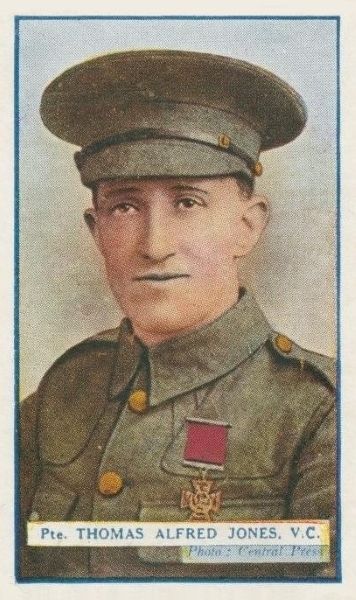
Postcards from the time pay tribute to the valour displayed by Thomas:
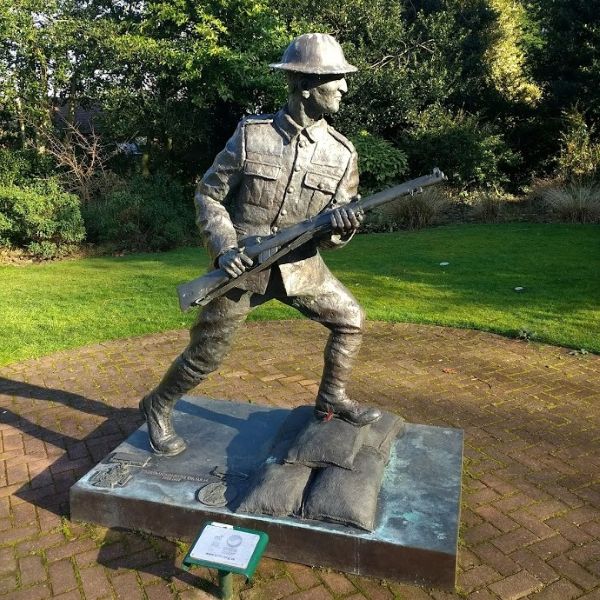
Bronze statue in Runcorn
On 3rd August 2014 a bronze statue of Todger Jones was unveiled in the Memorial Garden, Runcorn. It was created by the Scottish sculptor David Annand.
Information compiled for the Cheshire Roll by Shena Lewington (November 2026)
Thomas Alfred Jones was born on Christmas Day 1880, the son of Edward Jones (1842–1932) and Elizabeth Lawson (1848–1927). The family home was at 39 Princess Street, Runcorn, where Thomas grew up with his seven siblings: Joseph Edward (1869–1923), Emily (1870–1956), Frederick (1873–1925), Peter (1875–1926), Charles Arthur (1884–1917), (Sarah) Maude (1887– 1959) and Walter (1891–1937). Another sister, Lily (1888 – 1889) had died in infancy. Thomas was to be the longest-lived of all the boys, as none of the other brothers reached the age of 55. Read the story of his brother Charles who died in 1917.
Occupations
His father was a fitter at the Hazlehurst Soap Works, Runcorn, where he worked for 62 years. The family was Wesleyan, and Edward was also a preacher at the Ellesmere Street Free Church in Runcorn. Thomas was educated at Runcorn National School from 1885-1894, and started work as an apprentice fitter at the same firm that his father worked in. He later became an engineering fitter at the Salt Union Works at Weston Point, Runcorn, and returned to this occupation in 1919 after the war.
How did Thomas get the nickname Todger?
At school, he excelled at football and earned the name Dodger, which combined with his first initial eventually turned into Todger.
Enlistment
At the age of 19, Thomas first enlisted with the Runcorn Volunteers on 15th January 1900, a company of 2nd (Earl of Chester’s) Volunteer Battalion. It became 5th (Earl of Chester’s) Battalion, The Cheshire Regiment on 24th April 1908 on the formation of the Territorial Force. He was noted for his marksmanship and was awarded the Territorial Force Efficiency Medal in 1912. When he resigned from the Territorial Force in 1913, he went on to the National Reserve.
Family life
Thomas did not ever marry. He and Robina Abram (1895 – 1962) had a son, Thomas William Jones Abram, born on 8th April 1915, while Thomas was away in France with his regiment. In 1918, Robina married Joseph Griffiths (895–1962) and had a daughter Marjorie (1936 - ). Thomas Abram (1915 – 1986) was brought up as Joseph's stepson. He married Minnie Nash in 1939, and Thomas Alfred Jones became grandfather to Edna Abram (1941–1996) and Lynda (1947 - ).
The Great War 1914 - 1918
Thomas was recalled on 5th August 1914 and was attested at Runcorn on 31st August 1914. He would have liked to go into the Royal Engineers, but remained with the Cheshire Regiment. After training at Birkenhead, he was sent to France on 16th January 1915. He did not see his newly born son, Thomas William Jones Abram (1915 – 1986) until December that year by which time the baby was eight months old. On Christmas Eve 1915, he was punished for overstaying his leave in England by four days, forfeiting four days’ pay. One account records that his lateness in returning was due to his being treated for shell-shock, rather than deliberate absence without leave.
1916 - awarded the Victoria Cross, the highest award for gallantry in the face of the enemy awarded to British and Commonwealth forces.
"Looking back and thinking over the incident, I feel that I must have had what the poets call “a charmed life,” for, after jumping out of the trench and before I had accounted for the sniper in the tree, a bullet went through my helmet and was buzzing round my head-piece like a marble in a basis, finally galloping down my back and burning me during the journey. Four or five other bullets passed through my tunic, but I wasn’t aware of it until afterwards. It never entered my mind that I should be killed, and I didn’t think my time had come."
On 25th September 1916, during the Battle of Morval, Private Jones performed an act of bravery for which he was awarded the Victoria Cross. He was with his company covering the advance in front of a village, when he noticed an enemy sniper 200 yards (183 m) away. He left his trench on his own, and crossed no man’s land without any covering fire. Although one bullet went through his helmet and another through his coat, he returned the sniper’s fire and killed him. Near the enemy trench, he saw two more Germans firing on him while simultaneously displaying a white flag. Jones shot them both. Upon reaching the enemy trench, he found several occupied dugouts and single-handedly disarmed 102 Germans, and took them as prisoners of war. Three or four were officers, and the entire trench was taken by Private Jones and his comrades. The photograph below depicts him showing his damaged helmet to his parents.
The helmet is now on display at the Cheshire Regiment Museum in Chester.
The VC was presented by King George V at Buckingham Palace on 18th November 1916. The king asked him about his actions. Thomas’s account, in his own words, appears at the end of this page.
“How the dickens did you do it, Jones?” asked King George, as he invested Private Jones with the Victoria Cross
He received a civic reception in Chester and was presented with a gold wristwatch, a silver teapot, a case of cutlery and a pair of field glasses. He was given a hero’s welcome in his home town of Runcorn.
1917 Death of his brother Charles Arthur Jones
Thomas’s younger brother Charles Arthur Jones (1884–1917) of the 10th Battalion Cheshire Regiment died on 30th July 1917. He was 33 years old. His story is here.
1918 Distinguished Conduct Medal
Thomas was wounded and gassed on 4th August 1918 and admitted to hospital at St Omer the following day. Six weeks later, he was awarded the DCM for his actions at Beugny near Bapaume on 28th September 1918. The citation records that he went forward five times with messages through an intense artillery barrage. He also led forward stragglers to their positions.
Post war
Private Jones was discharged on 28th May 1919. Thomas returned to his pre-war job at the Salt Union Works, which was later taken over by ICI. He remained there for the next 30 years, until retirement in 1949.
During the Second World War, he was an ARP Warden and later served in the Home Guard. He was a member of the Liberal Club in Runcorn, winning prizes for billiards, and he also served as Honorary Secretary of Runcorn Reserves Football Club. At the end of his life, he was still living at 39 Princess Street, Runcorn, the house where he had been born.
Thomas was admitted to Victoria Memorial Hospital, Runcorn on 4th January 1956, and died there on 30th January. He was 75 years old. The causes of death were pulmonary embolism, auricular fibrillation and arteriosclerosis. He was buried in Runcorn Cemetery, his name inscribed on the family headstone, along with that of his brother Charles.
In addition to his VC and DCM, Thomas was awarded the 1914-15 Star, British War Medal 1914-20, Victory Medal 1914-19, Defence Medal 1939-45, Territorial Force Efficiency Medal, George VI Coronation Medal 1937 and Elizabeth II Coronation Medal 1953.
On 16th May 1956, his sister, Emily Lightfoot, donated the medals to the Cheshire Regiment Museum. The museum also displays the helmet that he wore in 1916, with the hole from a bullet.
PRIVATE "TODGER" JONES V.C. D.C.M TELLS HIS OWN STORY OF HOW HE CAPTURED 102 GERMANS
“How the dickens did you do it, Jones?” asked King George, when he invested Private Jones with the well-earned Victoria Cross. Here is the answer - “Todger’s” own modest account of his amazing feat. It is a story that will live. A record of dauntless pluck and unfailing cheerfulness in the face of death worthy of the glorious annals of the Victoria Cross. “If I’ve got to be killed, I’ll die fighting, not digging.” It was with these words on his lips that Private “Todger” Jones leaped from the British trenches. “Surely” said he, when approached afterwards, “there has been ‘nuff said, more than enough of a thing that was done on the spur of the moment by a man who kept his head and knew how to use his gun. But if you want to know what I did, let the official account speak for me”. “If that won’t fill the bill,” observed Jones, “I will tell you the story.” It was on September 25th that we took a village and were just beginning to dig ourselves in near the wood when bullets commenced to whiz past us, wounding one of our men in the head and making things decidedly uncomfortable. I felt the bullets ping-pinging by me and I said to the officer, “they’re going to make it hot for us, Sir, if we don’t get after ‘em. Can I get out and have a packet at them?” “My orders are to consolidate this position,” replied the officer. “You must not go an inch farther, and you had better get on with your digging.” And dig I did, but as I got up again I saw a chap hit through the head and another through the thigh. Looking ahead, I saw what appeared to be a white flag, and that fairly riled me. My “dander” was up and I shouted to the officer, “What do you think of that, Sir?” “You must get on with your digging, Jones” said he; but up I jumped and called out, “If I’ve got to be killed, I’ll die fighting, not digging.”
I waited no longer, but dragged out my rifle, flung down my entrenching tool, jumped out of the trench and went across. The Huns were a couple of hundred yards away and they could see me coming. One bullet went “sss” through my steel helmet and four more through my jacket. There was a sniper in a tree but I soon counted him out. On I went and reached a “bay”, or traverse, leading to the German trench. There were three men in it, but jumping in at the end of the trench, I had only one at a time to deal with. I got my back to the wall, and they whipped round on me. I always believe in firing from the hip and very quickly number one dropped dead. Before the next man could recover his senses, I had shot him as well, slipped another cartridge in the breech and got the old magazine going on the third at a yard range. The other man fired at me from the entrance to the dugouts, but I managed to “get there” first every time, which is a great thing in jobs of that kind.
In the second traverse there were five chaps standing behind one another. One of them made for me with his bayonet, but I bowled him over like the others by the old trick of shooting from the hip. I got the five of them. I stalked through the trench, storming and shouting and hearing the firing and the commotion, the rest of the crowd bolted in the dugouts. Soon they had all gone to earth and I was there alone. When they got into their dugouts I had them. They were shouting and screeching, and every time I saw a movement I let fly. Eventually they quieted down and seeing some of their bombs, a pile of them, on the floor of the trench, I picked up a couple and sent them flying down the first dugout and they went off all right. I think they felt that the game was up when the bombs began to drop amongst them, for out rushed three fine specimens with their hands up and the usual cry - “Mercy, Kamarad!” They had left equipment behind them to show there was no “monkeying” and though I felt like laughing at being there all on my own, I demanded in a stern voice if any one of them could speak English. One of them called out “I can.” “Well,” said I, “what is it to be? Do you want to be killed or taken prisoners? You can have it either way you like, for I am not particular. In fact, I would rather kill you.” And all with one consent actually cried out that they wanted to become prisoners and with Private Jones as their jailer, too! I looked round and saw a hollow, so I told the English-speaking German to order his two mates to get in there. They had to climb up to do it, and I knew our chaps would see them from our trench as they got on top. “How many more are there down the dug-out?” I asked, and the Boche answered “About fifteen”. “What about it?” I said, and he replied, “What do you mean?” “Do they want killing or what?” said I, and he gasped, “I don’t know.” “Well then,” said I, “go and tell them what I have told you - that they can either be killed or taken prisoners and they can bloomin’ well please themselves about it.” And by gum! He went and told them and came back to say they would all be taken prisoners. “Well then,” said I, “tell them they can come out when you call, but only one at a time, remember, and any one of ‘em that has as much as a penknife on him, or any equipment, will be shot dead straight away. Fetch ‘em up one at a time and tell them that my mates are coming across in thousands in a couple of minutes and if they find anything wrong with me, they’ll cut you to bits.” I heard him yowling down the dug-outs what I had told him and meanwhile I got round the cover. Presently he came back and said, “Are you ready?” “Yes,” I replied, “Call them up, and only one at a time and no rushing.” He shouted the message and ordered them out without equipment. There were eight or nine dug-outs in all and they kept tumbling out and as they came I sent them out of the trench into the hollow I’ve told you of. Lord! I’d expected fifteen and out they came in scores and went in my “compound.” When they were all out, I threw some of their own bombs into the dug-outs to make sure that there was no sniper left behind to “do me in.” And then I said to myself “Great Scot! What am I going to do with this little lot?” I knew I could eventually rely upon somebody coming from our trenches, but it was necessary to gain time. It’s not that I want to brag, but I didn’t turn a hair; I just kept my head-piece going. I told them it would be a very cold night at the place where they were going to, and suggested they had better get their great-coats. I graciously permitted them to fetch them “two at a time, and no rushing.” They ran and came in and out, and each time they passed me they saluted me, Private Jones! - and I sent them to their places. I didn’t like the look of one “bloke” and kept half an eye on him. “I think I’ll shoot that chap,” I said to the interpreter. “Don’t,” he exclaimed, “he very good man.” But presently the “very good man” went for his great-coat and when he had got a short distance, he made a dash for liberty. I swung round, clicked my rifle and got him fair and square. He rolled over and over just like a rabbit. Then I turned to the German by me. “Ask them if any more would like to try to escape,” I said. He did so, and they all jumped up - they were seated on the ground - flinging up their arms and shouted “Kamarad!” It fairly tickled me to death that did and I couldn’t stop laughing. Here was I playing a lone hand, for it looked so comical to see them all with their hands up - over a hundred of ‘em - hoping against hope that Private Jones, Kamarad, wouldn’t shoot. I wondered what was going to happen next, for it was out of the question that one chap could keep them there for any length of time. But the bowling over of the chap who tried to escape was the best thing that could have happened to me and it fairly put the fear of God into the rest. The official report speaks of me bringing in a hundred and two, but though I didn’t check their numbers, there must have been nearly a hundred and fifty of them when I got them into the open including four or five officers and any number of “non-coms” or whatever the Germans call them. But before they got into our lines, over forty of them were killed by our shells, which were sweeping the ground and clearing things up. I then saw somebody start from our lines. It was my chum coming to look for me. He had been asking where I was and when they told him, he said: “If Todger’s across there, I’m going to fetch him, dead or alive!” They all though I was a “goner,” but, when they saw my chum start, three more chaps - a sergeant-major, a corporal and stretcher bearer, came across with him. Seeing I was alive, my chum gave me a smack on the face and couldn’t stop larking. They helped me to “round up the bag” and we marched them back to our lines. All the time our guns were knocking the position to bits and as I’ve said, some of the shells dropped amongst the prisoners and killed them. I got a shrapnel wound in the neck from our barrage. Looking back and thinking over the incident, I feel that I must have had what the poets call “a charmed life,” for, after jumping out of the trench and before I had accounted for the sniper in the tree, a bullet went through my helmet and was buzzing round my head-piece like a marble in a basis, finally galloping down my back and burning me during the journey. Four or five other bullets passed through my tunic, but I wasn’t aware of it until afterwards. It never entered my mind that I should be killed, and I didn’t think my time had come. Asked if he could explain how he was led into the exploit “Todger” said, with a grin, “when I saw the first three men in the bay I knew I was up against something, but I had been in more than one tight corner before and I had learned that the art of warfare - for the individual, as any rate, was to size up a situation quickly, to fire without hesitation. My motto is never to lose this (significantly touching his head). The man who loses his “nob” is done for. I knew if I had to go I should, for everybody has his time, that’s what I believe and I meant to sell myself at a good price. But when I got the first men in the traverse and drove the others back into the dug-outs, I felt that the game was in my hands. I had them at my mercy; they didn’t know I was unsupported, cowed them into submission to my orders. I pictured the end that awaited them if a hair of my sacred head was singed and my trump card was played in making them come out one by one.
From “The Poona Star” (24th August 1929)
Postcards from the time pay tribute to the valour displayed by Thomas:
Bronze statue in Runcorn
On 3rd August 2014 a bronze statue of Todger Jones was unveiled in the Memorial Garden, Runcorn. It was created by the Scottish sculptor David Annand.
Information compiled for the Cheshire Roll by Shena Lewington (November 2026)