


Daniel's Story.
Daniel Archibald was born in the parish of St. Alban’s, Macclesfield, Cheshire, in 1870, and in 1891, he was employed as a Tailor. He had also briefly served in the Royal Navy.
On 7th August 1891, he went to Manchester, and joined the Manchester Regiment (No.3293) (although his service papers do actually state that he joined this regiment at Kinsale, Ireland, on 14th June 1891, and was subsequently attested at Manchester, on 7th August 1891). At the time of enlistment, he was aged 21 years 3 months, and had originally shown interest in joining the Royal Artillery. Daniel Archibald (it is not known why he took the alias Dan Maloney) was recorded at his medical as being 5ft 8in tall, weighing 137 lbs, with a fully expanded chest of 38in. His complexion was described as being fresh, and that he had brown eyes, dark brown hair. His religion was noted as being Roman Catholic, and that he had a scars on the front of his left upper arm, the upper left temple, and on the back of the left thigh. On completion of his medical, Daniel Archibald was posted to the 1st Bn Manchester Regiment. A year after his enlistment, he was in confinement on 27th August 1892, and subequently tried by Divisional Court Martial on 6th September 1892 (no specific reason is given for this trial), and he was sentenced to 84 days imprisonment with hard labour. However, this was remitted from the date of embarkation for India. Private Archibald was sent to India on 15th November 1892, and on arrival he was transferred to the 2nd Bn Manchester Regiment. During his service in India, he was appointed to the rank of Lance Corporal on 12th September 1893, and confirmed in that rank on 11th June 1894. He also gained a Cerificate of Education 2nd Class in that same year. Only a short time after being confirmed in the rank fo Lance Corporal, Daniel Archibald was tried and sentenced to 6 calender months imprisonment with hard labour (once again, no reason given) and almost certainly demoted, on 5th July 1894, however, 2 months imprisonment with hard labour was remitted on 7th July 1894, and Private Archibald was released on 5th November 1894. Within a matter of a few months, he was back in trouble when he was awarded 10 days imprisonment with hard labour by his Commanding Officer (once again – no reason is given) on 25th June 1895, and was released on 5th July 1895. Private Archibald was re-appointed to the rank of Lance Corporal on 23rd October 1897, but reverted to the rank of Private on 20th December 1897. By August 1898, he was serving with his battalion in Aden, and on 18th August that year, extended his service to complete 12 years service with the colours. On 16th November 1898, he returned to England.
On 15th March 1900, Lance Corporal Archibald arrived with his battalion in South Africa, and on 1st June 1901 he was confined for 1) When on active service drunkenness, and 2) Conduct to the prejudice of good conduct,” and tried by Field General Court Martial, and was awarded 14 days imprisonment with hard labour on 2nd June 1901. Later that same year, he was promoted to Corporal, on 29th September 1901, by the Commander in Chief, following the award of the Distinguished Conduct Medal for his actions that day. His citation for this award read:
“At Tyger Kloof, Orange River Colony, on 29th September 1901, he volunteered to look for three missing men and did so successfully under fire of 40 Boers.”
On 17th January 1902, Corporal Archibald was appointed to the rank of Paid Lance Sergeant, on 17th January 1902, and promoted to Sergeant on 11th March 1902. Sergeant Archibald returned back to England on 27th October 1902. For his services in the South African War (1899-1902) he was awarded the Distinguished Conduct Medal, Queens South Africa Medal, King’s South Africa Medal, and was “Mentioned in Dispatches” 5 times.
Following his return from South Africa he re-engaged to complete 21 years service with the colours, on 4th June 1903, but on 10th August 1903, he was tried again by General Divisional Court Martial for striking a soldier. Sergeant Archibald was reduced to the rank of Corporal. On 18th February 1904, while serving with “B” Company 2nd Bn Manchester Regiment, he was finally discharged from the army. His conduct and character while serving with the colours was described as:
“Fair – addicted to drink but is a good soldier and did excellent work on active service and gained the Distinguished Conduct Medal.”
In 1906, Daniel Archibald married his Canadian wife Letitia (born in Ottawa, Canada, in1870), and the following year had a daughter, Christina Archibald (it is not known if Daniel Archibald had gone to Canada, or if this child was born to his wfe before they married, as she was born in Sale, Canada). By 1911, they had settled in Birkenhead (his sister, Mrs Rutter, lived at Victoria Cottage, Heathfield Road, Birkenhead), and were living at 26, Park Street. Daniel was then a self employed Provisions & Coal Dealer. His wife, Letitia Archibald, assisted him in the business.
On 10th August 1914, Daniel Archibald re-enlisted at Chester, into the Cheshire Regiment, and was promoted to Sergeant, but was not sent to France until 9th September 1915, and was then posted to the 2nd Bn of that regiment. He was killed in action near the Hohenzollern Redoubt, near Loos, on 3rd October 1915. Private J. McNally, 2nd Bn Cheshire Regiment, wrote the following letter to Sergeant Archibald’s widow:
“Just a line in answer to your letter in which you ask for further particulars regarding the death of your husband. Our company were in the act of relieving another company of a different regiment, when two sergeant’s were killed, with the result that your husband was left in command of the platoon. Just after we had got into the trench, which was more like a ditch than a trench, the German’s bombarded with bombs, etc., and it was during this that your husband got his death blow. He was standing up to see if the German’s were coming towards us, when a bomb hit him. While lying on the bottom of the trench, and before the stretcher-bearers could move him, he got hit with another one which mortally wounded him. However, he did not die until a few hours afterwards, during which time he was quite conscious and kept on telling his men to keep a good look-out for bombs and trench mortars. I could not tell you exactly how long he lived, because the enemy kept us too much occupied, but I do know that practically his last words, if not his last, were to someone in my company to let his wife know of his death.”
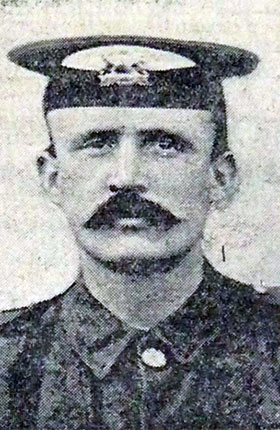
Picture from the Birkenhead News
Picture from the Birkenhead News
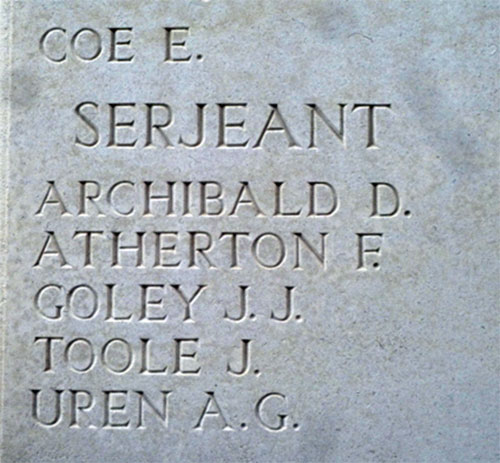
Sergeant Archibald’s body was never recovered and identified from the battlefield, and is therefore commemorated on Panel’s 49 & 50, The Loos Memorial, France.
Researched and compiled by Peter Threlfall.