


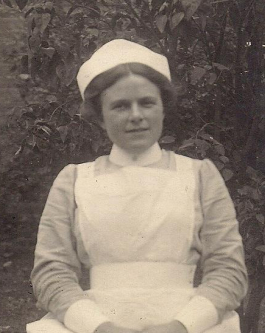
Margaret's Story.
Margaret Gleave is one of eight ladies named on the R.o.H. at St. Mary’s Weaverham. (Date of the photgrah is not known and may be post WW1.)
The 1911 census has a Margaret Gleave living at Manor Farm, Acton Bridge, with her uncle John Gleave who was a farmer. Margaret is recorded as having been born in Weaverham and was aged 19 in 1911. Employment is recorded as School, so is she teaching but where, Weaverham, Northwich or even Runcorn?
Checking the 1901 census we find Margaret with her family at Church Farm, Weaverham; Charles Gleave, father head of the family age 39, farmer at home, born Weaverham; Betsy, wife aged 32 born Norley; Margaret, aged 9 born Weaverham; other members of the family include Miriam, George, Ella, Ida, John all born Weaverham. Charles’s mother Margaret, aged 77, also lived with the family. Post the 1901 census there was Laura, born 1902, Ethel, Born 1904, Mary, born 1906 & Thomas, born 1908. Church Farm would be in the Farm Road area of Weaverham. Charles Gleave had married a Betsy Eaton at St. Mary's Weaverham in 1891.
Margaret’s information was initial found on “Findmypast,” she was with the British Red Cross Society. The information records Margaret living at Church Farm, Weaverham, she had volunteered on 20/12/1915 which is also stated as her Engagement date, Margaret was 24. Her service ended on the 2/12/1918, her rank at termination was Sister. Her commission was France with engagements at No 9 Red Cross Hospital Calais, also at St Omer, Hazebrouck and Roubaix. The document also states she was recommended for a Mention in Dispatches, Gazetted 21/8/1919. Her character is with “good record. Delicate.” Mention in Dispatches; This would be announced in the London Gazette which is likely to have been transferred to the local paper but no article found.
N.A.M.C. have two medal cards for ladies named Margaret Gleave, one believed to be this Margaret Gleave. The Corps is Ref. BRCrossJJ, British Red Cross and St. John of Jerusalem. The medals awarded appear to be 15 Star and BRX/7, with the T.o.W 1 (France) and D.o.E. 20/12/15.
After contacting the Chester Military Museum for guidance and a better understanding of the research their volunteer, (Bill) took up the research and found some information on Margaret and sent the relevant documents through including the London Gazette information. The “Mention in Dispatches” date given of the 28th Aug. 1919, was wrong and was in fact the 10th July 1919, again no local newspaper article found. The documentation covered much of the information already found therefore confirming that data. Some of the additional information was on Margaret's family and on the hospitals she would have worked in. Other points of interest; the documentation states her rank at engagement as Sister. Does this implies she was already been nursing? Margaret's date of disembarkation is given as 20th Dec. 1915. Her pay at engagement is stated at £1-1s-0d. It goes on to state her pay at termination which was £1-4s-0d. Margaret was awarded the 1914-15 Star medal and the British Red Cross Society & and Order of St. John medal. The family information did not mention any marriage and stated “death unknown”. The online forces war information records a Margaret Gleave Cert. No 7494 & Passport No 17679, with Rank N.S. (Nursing Sister) 1914 Unit, Red Cross. (The 1914 – 1918 dates get thrown about a lot as these are the generic dates of the conflict and may not always be the actual date.)
The information from the Military Museum included some data on the hospital from WW1; “No 9 British Red Cross, (known as the Duchess of Sutherland’s Hospital or Millicent Sutherland Ambulance, 100 beds.) was at Calais Jan. 1916 – March 1918; Longuenesse March 1918 – Sept. 1918; Hazebrouck Sept. 1918 – Oct. 1918; Roubaix Oct. 1918 – Nov. 1918. We do not if Margaret had been with the No9 Red Cross Hospital from her posting at the end of 1915, but the start date for the No 9 Red Cross Hospital at Calais in Jan. 1916.
The following information on the No9 Red Cross hospitals has been taken from the “Western Front Information and the Long Long Trail” No 9 Red Cross Hospital, known as the Duchess of Sutherland’s Hospital or Millicent Sutherland Ambulance, 100 beds, was administered and financed largely by the Duchess and was recognised for its efficient use of a new, revolutionary treatment of wounds known as the Carrel-Dakin treatment. This consisted of constantly irrigating wounds with a highly diluted antiseptic of sodium hypo-chloride and boric acid. The main advantages of this treatment were that old infected wounds could be cleaned up, healing quickened and that the general condition of the patient improved almost immediately once the treatment had begun. The hospital also provided excellent treatment of fractured limbs by means of suspension and extension. The total number of patients treated between 12 January 1916 and 20 November 1918 was 5,914. The hospital which included reference to 100 beds reached a maximum of 120 beds, was located and relocated at Calais, St Omer, Hazebrouck and Roubaix.
Trying to find a later Gleave family in the area was proving a little difficult, not least as the name Gleave was quite a well used in the area and they also appear to be separate families. Success came with Mr. Ed, Nagle and through his family connections to Mr. Malcolm Okell. Margaret was Great Aunt to Malcolm. Margaret's sister Ida was Malcolm’s grandmother.
Mr. Malcolm Okell has supplied the following information; Margaret Gleave was born 8th December 1891 at Church Farm, Weaverham. Her father was Charles Gleave, a farmer, and her mother was Betsy. Margaret was the eldest daughter. Charles and Betsy had a total of ten children over the following seventeen years. Margaret went to school, and eventually to Runcorn County Secondary School, where I think she must have then become a teacher. Her youngest brother and sister also went there. When World War One broke out Margaret, aged 23, joined the British Red Cross No. 9 Hospital as part of the British Expeditionary Force and went out to France, where she stayed until 1918. However at the end of 1918 she was taken ill and it was advised that she take a long period of recuperation. When she had fully recovered she then became a nurse at University College Hospital in London and lived in Gower Street. I understand that eventually she became a matron.
Margaret married Mr. Christopher Dean in the first quarter of 1922 in Sevenoaks, Kent. Margaret and Christopher had 3 children, two sons and a daughter. Her husband died in 1928 shortly after the birth of their youngest child, Tom. The daughter, Millicent, born in 1922, later helped with the war effort in World War Two, working at Bletchley Park near London. Margaret remained at Kimbolton until her death on the 9th January 1966, living with her daughter Millicent. Her funeral was held at St. Andrews Church, Kimbolton, Huntingdonshire.
Mr. Malcolm Okell forwarded copies of the following:
1) Letter from Runcorn County Secondary School, 30th ? 1915 to Margaret. (The date on this letter is uncertain. Having said that the month does not look like December.)
2) Letter to Mrs Gleave, Jan. 28th 1918, which is signed by Millicent Sutherland.
3) Letter stamped No9 Red Cross Hospital, dated 25th Nov. 1918. to Mrs Gleave re Margaret having had Flu and being very unwell.
These letters even in these brief forms say an awful lot about Margaret, especially the exhausted state she must have been in at the end of the conflict and after the flu. Also about Margaret’s mother, Mrs Gleave and the items she must have sent through to the hospital. This was not just a one off event but a regular supply of much needed food and consumable goods. See N/wich Guardian articles following the letters.
A big thank to Malcolm for sharing Margaret and her family history.
Transposed letter from Mr. Gledhill,
County Secondary School,
Runcorn 30th ?? 1915.
Headmaster L. Gledhill
The Firs
Dear Margaret
Thank you for your interesting post card. So you are in France now! Perhaps you will pick up the spoken language quicker than it is possible to learn it from books. You must be having an interesting but heart rendering experiences out there. We shall look forward to your safe return when we shall hear the full story of all you have (come) across. We are going on very well at school. We have about 50 names on our Roll of Honour. I suppose I must now begin one for the girls. Yours is the first case I have heard about. I think your little people will do us credit later on. I haven't so far been in contact with Ethel but I teach Mary & Tommy practically all the week. I regard Mary as a first class scholar and she should do really well. Tommy is about the pleasantest little chap I have come across. He is bright intelligent & will I hope develop into a smart boy. Of one thing I am quite sure that they are very happy at school. We have a big family ourselves now. We have 4 of my nephews & nieces with us, 3 of whom go to the school so Mrs Gledhill has a very busy life. We shall be anxious to hear how you get on & and wish every good wish for your safety & prosperity & with kind regards from all here.
I am your sincerely,
L. Gledhill.
Transposed letter from Millicent Sutherland, Duchess, to Mrs Gleave. (Mother) B.R.C.9 aPo4 , B.E.F.
Dear Mrs Gleave,
You have been so kind & generous to this Hospital. The chickens are flourishing – all ready in full feather. Your daughter is a polished nurse - charming young person – we are fortunate in having her services.
Thank you again, Believe me.
Yours Sincerely, Millicent Sutherland
Jan. 28 1918.
Transposed letter informing Mrs Gleave how ill Margaret had been.
No 9 Red Cross Hospital Millicent Sutherland Ambulance,
Post Office British Expeditionary Force. 25.11.18
My Dear Mrs Gleave,
I'm awfully sorry to tell you your daughter has been very ill with flu. She is better again now but in a very weak exhausted state of health & will want medical ?? and a very very long rest. I want to beg of you dear Mrs Gleave not to let her go to Watford to work for at least a year. It will be fatal if she starts work before at least a years rest. Words will never express to you what an excellent Sister she has been. She has never spared herself in any way. I know she is really tired & worn out with the very hard work of four years. I want to express to you also our appreciation of all your kindnesses to the patients & the Staff. What we would have done without all your food things, I can't think. A thousand thanks to you for all you have done.
Yours very sincerely
????
The following articles were found in the Northwich Guardian;
10th March 1916; FOR THE WOUNDED APPEAL FROM MILLICENT DUCHESS OF SUTHERLAND.
Gifts may be sent through Weaverham Lady.
We have received a letter from Millicent Duchess of Sutherland in which she makes an appeal for butter, eggs and vegetables for wounded soldiers in the Red Cross Hospital, which was established by her Grace and is under her personal control. The nursing staff of the hospital includes Sister Margaret Gleave, a Weaverham young lady and the Duchess especially refers to the efforts of Miss Gleave in obtaining subscriptions to purchase trolleys to carry surgical dressings in the ward of which she is in charge, The letter is addressed to the Editor of the “Northwich Guardian” from the British Red Cross No9 (Millicent Sutherland Ambulance) and reads as follows:-
Sir, - Through Sister Margaret Gleave one if the nurses in this hospital we have received for her hut – a ward of 30 beds – trolleys to carry the surgical dressings from case to case. The usefulness of this gift cannot be too highly praised. May I take this opportunity of thanking very warmly all those who subscribed. The work in our hospitals is very heavy indeed, as we take cases that come in barges from the front. The Army give us rations, but it is necessary slightly to argument them and gifts of butter (slightly salted) and eggs well packed sent through Mrs Gleave, Church Farm, Weaverham, Northwich, who has promised to collect them or direct to my secretary, Miss Neroutsos 39 Portman Square. London, W. would be immediately forwarded to us and gratefully acknowledged. Sacks of potatoes and other hardy vegetables in season would also be of immense value. Miss Neroutsos would gladly forward labels. Yours Millicent Sutherland.
[V.A.D. records have a Miss Florence Neroutsos, Colchester, Essex. Secretarial & Accounts, dates do not add up. i.e. V.A.D. records and letter date.]
[V.A.D. records have a Miss Florence Neroutsos, Colchester, Essex. Secretarial & Accounts, dates do not add up. i.e. V.A.D. records and letter date.]
27th July 1917, P5/C1; EGGS FROM WEAVERHAM FOR WOUNDED.
MILLICENT DUCHESS OF SUTHERLAND’S APPRECIATION TO THE EDITOR.
Sir – I should be grateful if you would insert the short letter of thanks to the people of Weaverham, Acton Bridge and Norley who have sent through, Mrs Charles Gleave, Church Farm, 3,000 eggs to my hospital. It is almost impossible to say how great a boon these are; fresh eggs are a rarity in Northern France & to get them in any number would of course be hopeless. We therefore largely depend on this connection of eggs: They are so much appreciated by the wounded soldiers. We have nearly doubled our accommodation here in the last month and we only have stretcher cases. We so much hope our friends in England will not forget us and continue their valuable help during this long and difficult war,-
Yours &c
MILLICENT SUTHERLAND (DUCHESS OF).
17th Aug. 1917, WEAVERHAM
Eggs for the wounded:- The following article appears in the Weaverham Parish Magazine; “Our readers will be glad to hear that the number of eggs collected on behalf of our wounded soldiers in response to an appeal from headquarters amounted to 678. Great praise is due to our lady workers who left no stone unturned to make the collection so great a success in Sandiway.”
The story continued for the Gleave family with Margaret’s daughter Millicent Dean serving in WW2.
George, brother, was in the RAF as a flying instructor and lived at Heswall in the Wirral. George will be another Cheshireroll story in time.
Research Bob H.