


Henry's Story.
Private Henry Higginbotham, 4th Battalion Cheshire Regiment, army number 3245, was deployed to South Africa for the Second Anglo Boer War, arriving there on 16th March 1900. Two months later, on 13th May 1900, he died of enteric fever (typhoid) and pneumonia at the Stationary Hospital, Sterkstroom aged 24 years old.

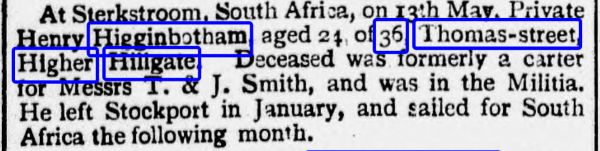
London Evening Mail 16th May 1900
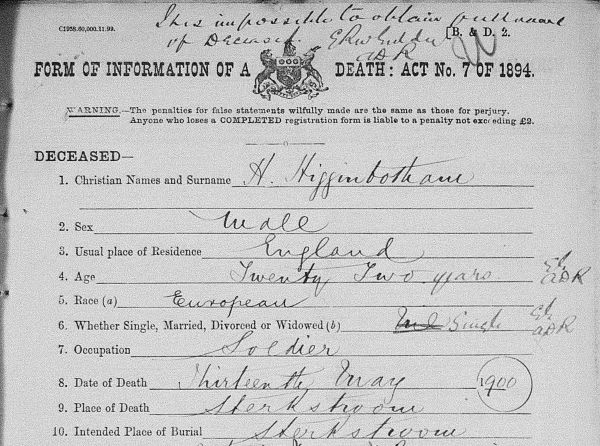
His entry for burial shows his age as 22, though he was older than that, but no details of next of kin, apart from a note that the soldier was unmarried appears on his documentation. Private Higginbotham had been ill for fifteen days.
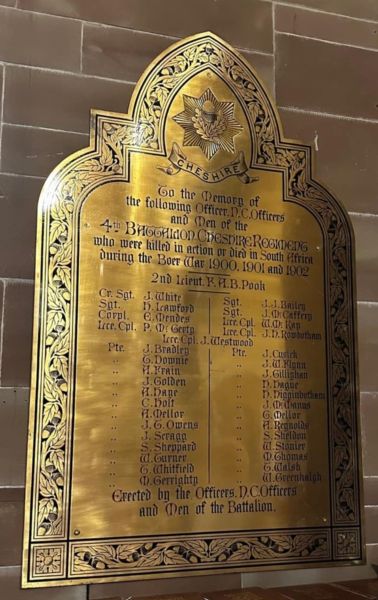
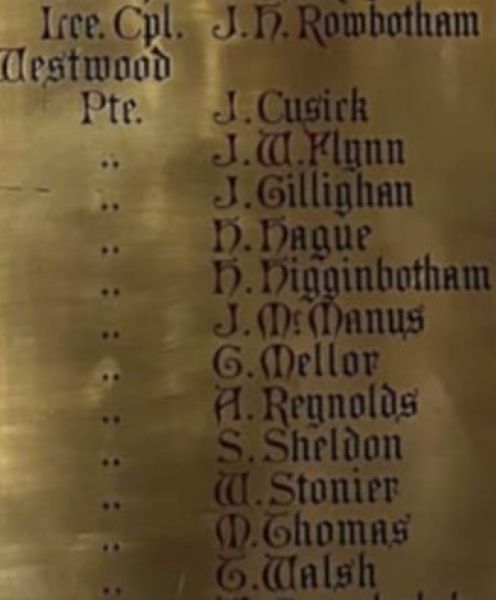
n 1901, Private Higginbotham was posthumously awarded the QSA medal, with clasps for Cape Colony and Orange Free State. He is commemorated on a brass plaque in St Michael and All Angels Church, Macclesfield.
Henry Higginbotham (also Heginbottom) was born in the summer of 1876, the son of Abel Higginbotham (1847 - 1887) and Mary Ashton, and brother of Mary Ellen, Harriet and Emily. He grew up in Stockport, at 2 Longshut Field. His father Abel was a hatter, like many workers in Stockport at that time. In 1887, when Henry was ten years old, his father died, aged 40, and the 1891 census shows his widowed mother Mary living with her three youngest children at 36 Thomas Street, Higher Hillgate. Henry enlisted into the Cheshire Regiment in 1899, and in February 1900 embarked for South Africa. The notice of his death in the local newspaper reports that he had worked as a carter for Messrs T and J Smith.
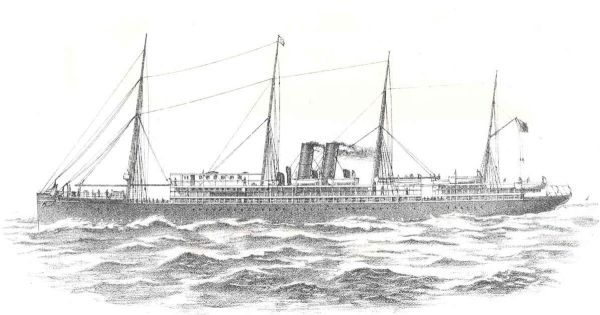
The 4th Battalion the Cheshire Regiment was embodied for service in the Second Anglo Boer War in January 1900. They sailed for South Africa on the SS Orotava (pictured above) on 24th February 1900, setting off from Queenstown in Ireland (modern day Cobh, County Cork) arriving in Cape Town about three weeks later, on 16th March.
Researched by Shena Lewington (November 2026)
London Evening Mail 16th May 1900
His entry for burial shows his age as 22, though he was older than that, but no details of next of kin, apart from a note that the soldier was unmarried appears on his documentation. Private Higginbotham had been ill for fifteen days.
n 1901, Private Higginbotham was posthumously awarded the QSA medal, with clasps for Cape Colony and Orange Free State. He is commemorated on a brass plaque in St Michael and All Angels Church, Macclesfield.
Henry Higginbotham (also Heginbottom) was born in the summer of 1876, the son of Abel Higginbotham (1847 - 1887) and Mary Ashton, and brother of Mary Ellen, Harriet and Emily. He grew up in Stockport, at 2 Longshut Field. His father Abel was a hatter, like many workers in Stockport at that time. In 1887, when Henry was ten years old, his father died, aged 40, and the 1891 census shows his widowed mother Mary living with her three youngest children at 36 Thomas Street, Higher Hillgate. Henry enlisted into the Cheshire Regiment in 1899, and in February 1900 embarked for South Africa. The notice of his death in the local newspaper reports that he had worked as a carter for Messrs T and J Smith.
The 4th Battalion the Cheshire Regiment was embodied for service in the Second Anglo Boer War in January 1900. They sailed for South Africa on the SS Orotava (pictured above) on 24th February 1900, setting off from Queenstown in Ireland (modern day Cobh, County Cork) arriving in Cape Town about three weeks later, on 16th March.
Researched by Shena Lewington (November 2026)