


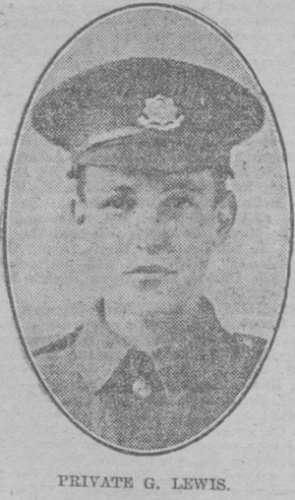
George's Story.
George was one six children born to George and Ellen Lewis of Foxwist Green, Whitegate.
George was born 10 October 1898; he appears on the 1901 census age 2. The family lived on Foxwist Green Farm, owned by John Tomlinson. His father also named George was working as a waggoner on the farm while Ellen carried out domestic duties, the children were, Jane 7, Florrie 5, Nellie 4, George 2, and John 7 months. In 1911 the family still lived on the farm, the census shows that George and Ellen had been married for seventeen years and that one of their six children had sadly died. The children listed were Nellie (Ellen) 14, George 12, John 10, and Sarah Catherine 7. Leaving either Jane of Florrie as the child who had died.
When war broke out the 2nd battalion Cheshire Regiment were in India, they returned to England landing at Devonport on 24 December 1914, they then came under the orders of the 84th Brigade and went to France 17 January 1915. George joined the battalion on 27 May 1915, he was 16 years 7 months old. By October the battalion were involved in the Battle of Loos and were stationed near Vermelles.
The fighting around the Hohenzollern Redoubt was particular intense. The war diary for October 2nd and 3rd state.
The fighting around the Hohenzollern Redoubt was particular intense. The war diary for October 2nd and 3rd state.
5am. 2nd October. The enemy bombarded the two companies holding the West Face of the Hohenzollern Redoubt with bombs, trench mortars and aerial torpedoes, the bombardment continued throughout the day.
12 Midnight. No.1 company supported by the Suffolk Regiment in an attack on the North West Face of the redoubt. Attack failed Captain Ogden (Durham Light Infantry) and 2nd Lieut Raikes were wounded. 2nd Lieut. Cole rejoined the battalion on having completed a course in the use of the Lewis Gun. Two Lewis Guns were brought with him into the redoubt. Enemy continued to bombard throughout the night.
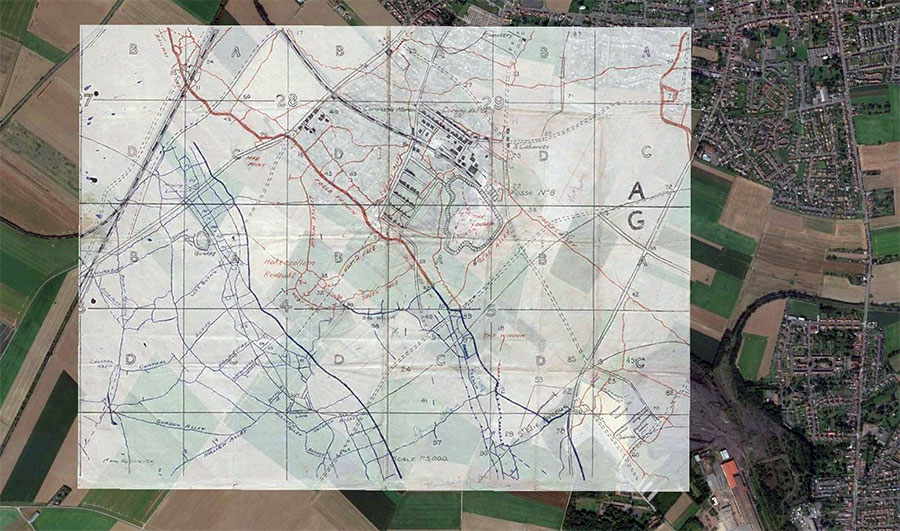
07.30am. 3 October. Captain Freeman was sent to command a part of the Northumberland Fusiliers on the South West side of the Redoubt, the two officers of this party having been wounded. Enemy bombing incessantly.
07.45 The enemy delivered an unexpected attack on our left with bombs and machine guns and eventually turned it. The battalion fought well but were driven back. Enemy occupied the West Face.
West Face of the Hohenzollern Redoubt.
Major Hill and Captain Lloyd were killed 2nd Lieut. Paton, Morris and Alderney wounded. 2nd Lieuts. Cole and Birch missing.
Casualties 30 September to the 3 October
Officers. 5 killed, 7 wounded 2, missing.
Other ranks. 43, killed, 153 wounded, 166 missing.
At 5pm on the 3 October the battalion was withdrawn to Vermelles.
Records now show that 5 officers were killed, others rank’s 153.
During the night of the 2/3 October George was working as a stretcher bearer bringing in wounded, for his actions, he was awarded a Distinguished Conduct Medal (D.C.M.) he was 16 years 11 months and 24 days old. An account of the actions he sent in a letter to his parents, which appeared in the local press.
Whitegate Boy Hero.
D.C.M. for carrying wounded.
On Saturday the village of Whitegate was elated by the welcome news that one of its soldier sons had won the Distinguished Conduct Medal, and he a mere youth of 17. Private George Lewis a stretcher bearer in the 2nd battalion Cheshire Regiment, and son of Mr. and Mrs. G. Lewis of Foxwist Green. The meritorious work which earned the coveted honour was performed on October 3rd, and as Private Lewis celebrated his birthday on the 10th inst., he was only really 16 years of age.
The circumstances as gathered from a letter written by private Lewis on October 20th, are as flows: On Sunday morning, October 3rd, the Germans made a very strong attack on the British and drove our men out of a small line of trenches. As they were retiring across the open to another trench about 150 yards back, the Germans poured a big machine gun and rifle fire on them. The consequence was that a lot of fellows were hit, and so disabled that they could not crawl to the shelter of the trench. Therefore, they lay in the open al day., between the two lines of trenches, as it would have meant certain death for anyone who ventured out to try and bring them in.
As soon as it was dark, however, the medical officer (Lieut Brown), together with private Lewis and the latter’s mate, Private J. Tucker, went out with the stretcher and brought in all the wounded men they could find. All the time they were out the Germans continued to fire “like mad,” as private Lewis describes it; evidently, they had an idea that some efforts would be made to gather in the wounded under cover of night.
“Lieutenant Brown (writes Pte. Lewis) got the Military Cross, and he deserved it. He is one of the best and bravest men I have ever met, and he went out to get wounded in for the love of the thing. As a medical officer, he need not have gone within six miles of the fire trench if he had no inclination that way.”
“My mate also got the D.C.M., and he nearly got something else, as a bullet struck him on the left breast pocket and penetrated through his small pocket book and a lot of letters, then glanced off, doing him no harm whatever. We have not been decorated yet, and I expect we shall have to wait till the next general inspection. The first thing I knew about it was when an officer came up to me, shook hands, and congratulated me. I think I can safely say that I am the youngest recipient of the D.C.M. in the British Army.
Chester Chronicle. Saturday, October 30, 1915.
It would take some considerable time and research to try and work out if George was indeed the youngest, to receive a D.C.M., however he will be one of maybe a few that could make that claim, it is a remarkable achievement for someone so young.
D.C.M. Citation.
Lewis. G., 25478
On the night 2nd/3rd October 1915, near Vermelles, the Germans expected an attack by us, and the fire on both sides was very heavy, in addition to which flares were being constantly sent up. Pte. Lewis and Drummer Tucker were ceaseless in their efforts to bring in the wounded men, who were lying between our own and the enemy lines. On one occasion they were fired upon by our own men, who were unable to distinguish who they were. They continued this work until after daylight, exhibiting marked courage. London Gazette. 16 November 1915.
This was not the end of his bravery, on October 25, the battalion left France, sailing from Marseilles on the S.S. Ivernia arriving in Alexandria four days later. In April 1918 George was awarded a Military medal (M.M.) for bravery in the field. Gazetted 10 April 1918.
George was demobbed April 21, 1919, he returned home to Whitegate. In 1939 he was living at 14 Greenhall Road, Northwich and working at the Chemical works. He is listed as single. It is believed at this moment that George never married or had children, he passed away 5 April 1969, age 70, and was still living at 14 Greenhall Road. In his obituary there is no mention of a wife or children, the mourners were his sisters and brother in laws.