


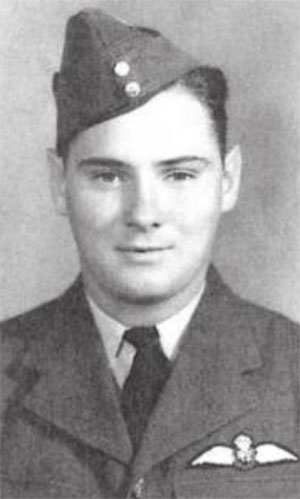
Albert Digby's Story.
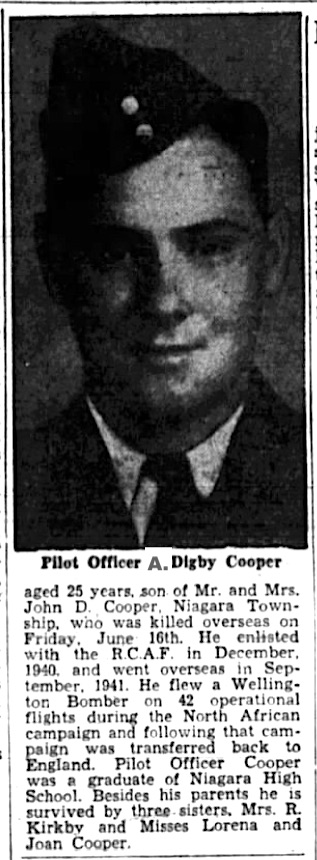
Albert "Digby" Cooper was born on 29th May 1919 in Niagara-on-the-Lake, Ontario, Canada. He was known to his family by his middle name and was the son of John Digby and Lorena Elizabeth Cooper (nee Burch). The family was a farming family. He attended school locally and in 1937 he begun working on his father’s farm. After initially serving in the Canadian Army in an auxiliary unit at Brantford for a short time he enlisted into the RCAF on 11th December 1940. He underwent pilot training in Canada being awarded his pilot's wings on 20th August 1941 before posting to the UK in October 1941. In UK he trained at 14 FTS (later known as 14(P)AFU). He was posted to 15 OTU flying Wellingtons in February 1942. In early April 1942 he had finished his training and was ready to fly operationally and had received notification that he was to be posted to the Middle East theatre of war. After a series of airtests he took off from Harwell airfield on 18th April 1942 in Wellington DV571 with Cairo, Egypt their eventual destination, via Lyneham, Port Reath, Gibralter, Malta and landing in Cairo on 23rd April 1942. The unit he was probably with for this flight was No.1 OADU. Two other Wellingtons flying the same route left Malta on the same date as DV571 but failed to arrive in Cairo, the bodies of fifteen airmen were never found and are commemorated on the Malta Memorial. He was posted to 108 Squadron on arrival in North Africa and by 10th September 1942 he wrote home stating he had flown 29 operational flights. On 3rd November 1942 during the second Battle of El Alamein he was flying Wellington Z1180 on an operational flight briefed to attack tanks and motorised vehicles retreating from the battle , during the flight the aircraft suffered an engine failure and Sgt Cooper was left with no option but to force land the aircraft in the desert some five miles south of El Alamein. He and his crew were able to walk back to their lines and re-join their squadron, receiving "The Order of the Flying Boot" an award granted to aircrew who had been shot down or force landed behind enemy lines and managed to walk back to safety In total he completed some 43 operational flights in the North Africa Campaign. He embarked a boat to return to the UK in early February 1943 and then served at 10 OTU and 22 OTU before training at No.3 Flying Instructor School in July 1943 and posting back to 22 OTU as a qualfified flying instructor. He received a commission to the rank of P/O on 30th July 1943 though this was later moved to 31st October 1943 having been involved in minor disciplinary proceedings for using colourful language at a dance in Leamington in March 1944. Following his death on 16th June 1944 when Wellington HZ715 that he was flying crashed into a mountain in Cumberland, his father received a letter from the Commanding Officer of Wellesbourne Mountford airfield dated 9th July 1944 to explain the burial arrangements which took place at Chester on Friday, 23rd June 1944 with the men based at RAF Sealand acting as Pall Bearers.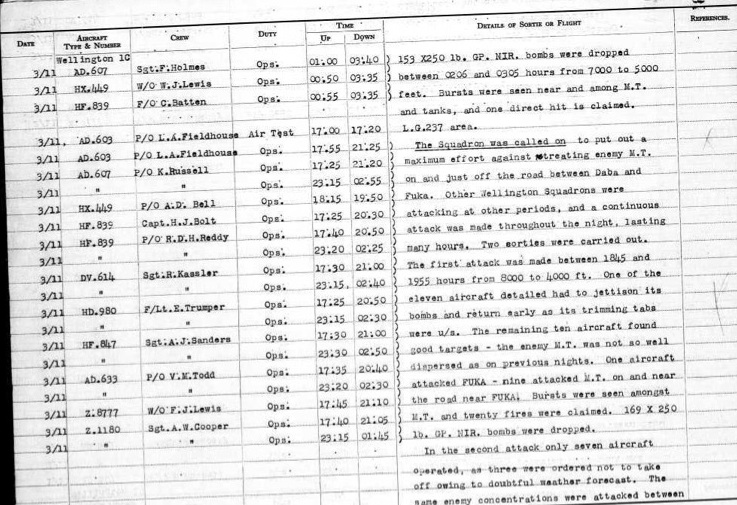
108 Squadron Record for 3 November 1942
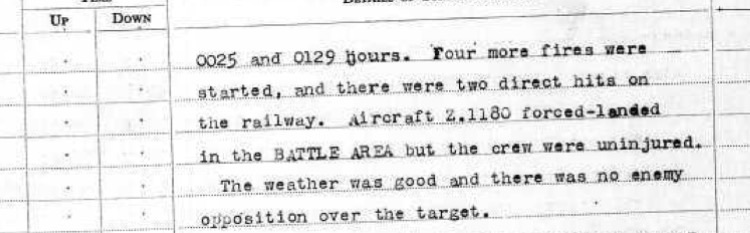
108 Squadron record 3 November 1942 continued

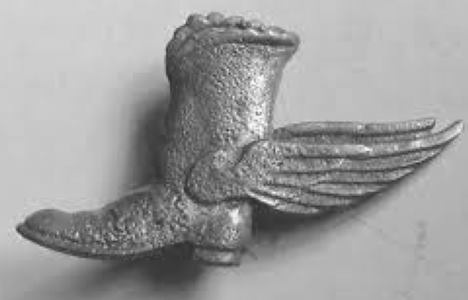
The Order of the Flying Boot
The Loss of Wellington HZ715
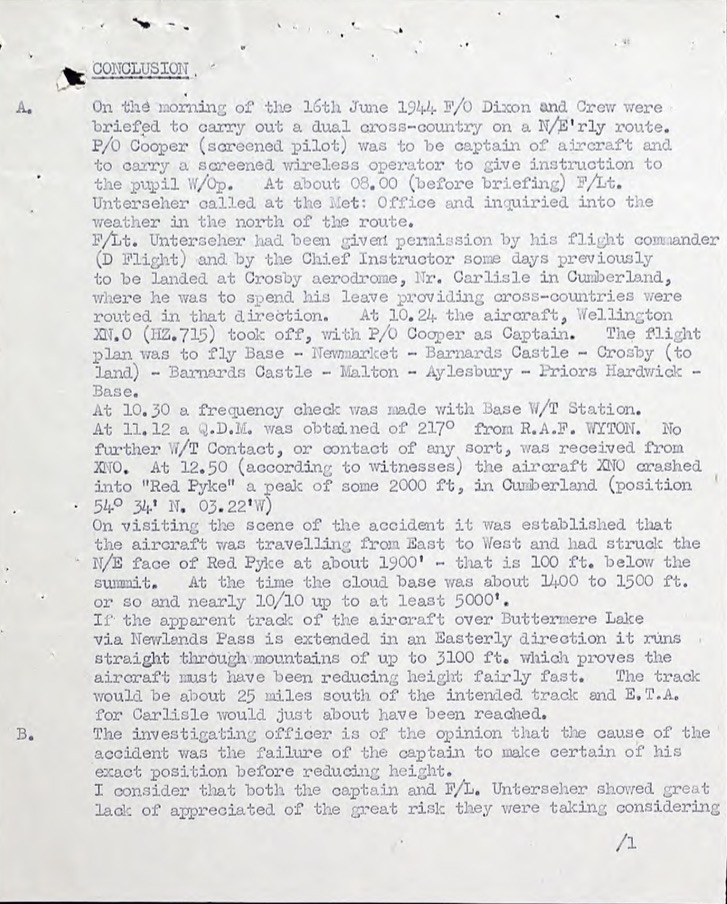
On 16th June 1944 Wellington HZ715 of No.22 Operational Training Unit was to be flown on a cross country training flight combined with a dual control flying exercise with a mixed crew. A trainee crew of five were to fly their first cross country flight in the Wellington, they were to be joined by two instructing aircrew; one giving wireless operating instruction and the other ( Albert Cooper) as a pilot instructor. Also on board was a passenger, Unterseher (who was also an instructor) making a total crew of eight. The route that was planned in advance of taking off was to fly from base of Wellesbourne Mountford and use turning points of Newmarket, Barnard Castle, Malton, Aylesbury, Priors Hardwick before returning to base. The passenger had obtained permission to obtain a lift to Crosby on Eden airfield, near Carlisle a few days before this flight as he was to go on a period of leave and his commanding officer had permitted him to fly in a passenger in a Wellington the next time a cross country flight was roughly in the area. The leg of this flight was then extended from Barnard Castle to head to Crosby on Eden to land and drop off the passenger before heading back south. With the route of the cross country training flight agreed the night previously, the passenger then checked the weather forecast prior to take off. The Met Officer later stated that he believed that the landing was to be made in Yorkshire and not at Carlisle and while the forecast was not at all good over the North of England it was deemed acceptable to fly the route and land in Yorkshire. In general this was a reasonably common occurrance for aircrew to use available aircraft to ferry themselves around when the opportunity arose. The Wellington took off from Wellesbourne Mountford at 10.24hrs and begun flying the planned route. All appears to have gone well until they passed Barnard Castle but then they appear to have flown into poor weather. Believing they were flying on the correct course they began to let down through cloud to make the landing at Crosby on Eden, what had actually happened is that they had flown off track by twenty five miles earlier in the flight and instead of making an east-west approach to Crosby they had flown across the northern Lake District from east to west and begun to let down through cloud while crossing high ground. Their course would have seen them cross over the "Dodds" / Helvellyn range at a safe height but then to descend reasonably quickly heading west flying roughly over the Newlands Pass, the aircraft was heard flying over Buttermere but then failed to clear high ridge between Red Pike and High Seat. It struck the rock face only feet below the summit of Red Pike at 13.35hrs killing all on board instantly.
Crew
Pilot (Instructor) - P/O Albert Digby Cooper RCAF (J/18201), aged 25. Buried Blacon Cemetery, Chester (A/1068).
Pilot (Pupil) - F/O Frederick Allan Dixon RCAF (J/35425), aged 27. Buried Blacon Cemetery, Chester (A/986).
Pilot (Passenger) - F/Lt Emil Unterseher RCAF (J/16129), aged 29. Buried Blacon Cemetery, Chester (A/322).
Navigator - F/O Daniel Titleman RCAF (J/38329), aged 26. Buried Blacon Cemetery, Chester (A/63).
Bomb Aimer - Sgt George McCrimmon Anderson RCAF (R/168378), aged 29. Buried Blacon Cemetery, Chester (A/896).
Wireless Operator / Air Gunner (Instructor) - F/O Roy Edward Simonson RCAF (J/19182), aged 23. Buried Blacon Cemetery, Chester (A/149).
Wireless Operator / Air Gunner - WO1 George Richard Coathup RCAF (R/115256), aged 23. Buried Blacon Cemetery, Chester (A/279).
Air Gunner - Sgt Campbell McRae Hodges RCAF (R/266186), aged 34. Buried Blacon Cemetery, Chester (A/806).
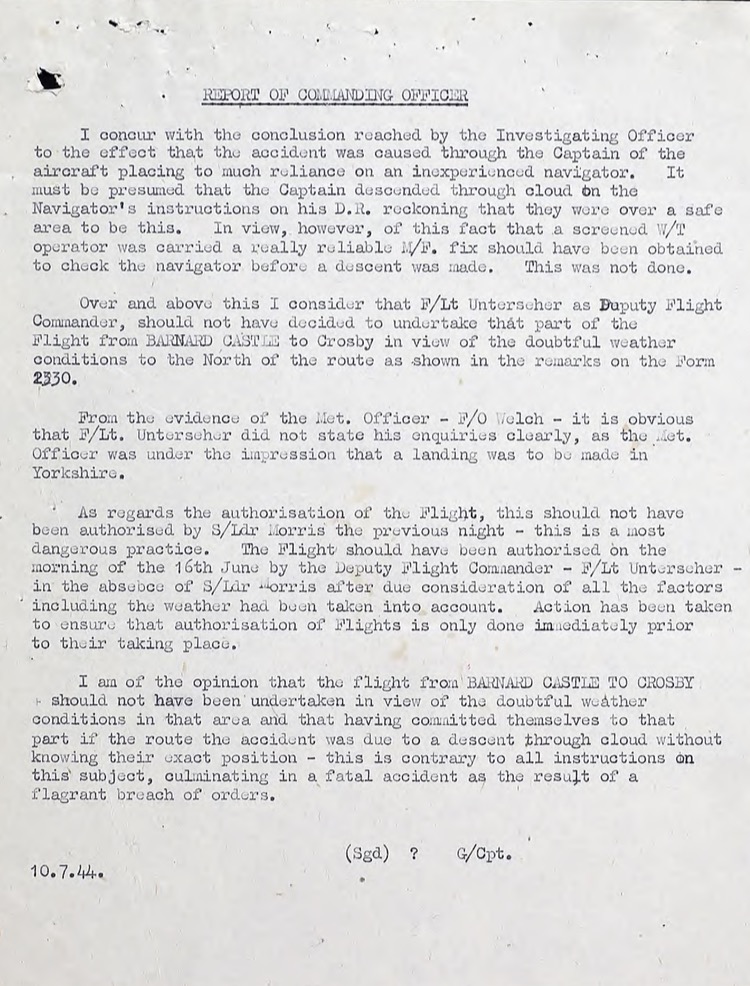
The enquiry into the accident found that the primary responsibility for the accident was that the Captain, Cooper, had not determined his location properly before commencing a descent through cloud which was not in accordance with standard operating procedures. The passenger Unterseher was also partly responsible because he had obtained an incorrect weather forecast from the Met Officer prior to the flight. Other contributing factors were determined to be:
1 Approval for the flight and the detour to drop off the passenger was given the day before the flight meaning that the decision was made without full knowledge of the weather conditions.
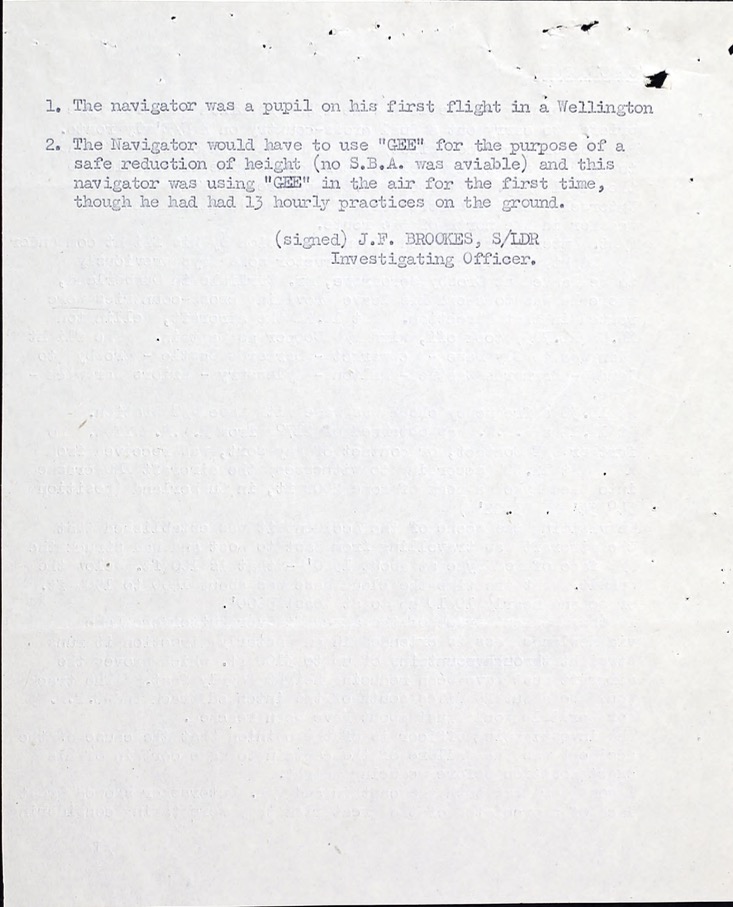
2 The navigator was on his first flight in a Wellington and his determination of the aircraft location should have been cross checked
3 The navigator had never used GEE position locating equipment in the air before and had only practiced its use on the ground
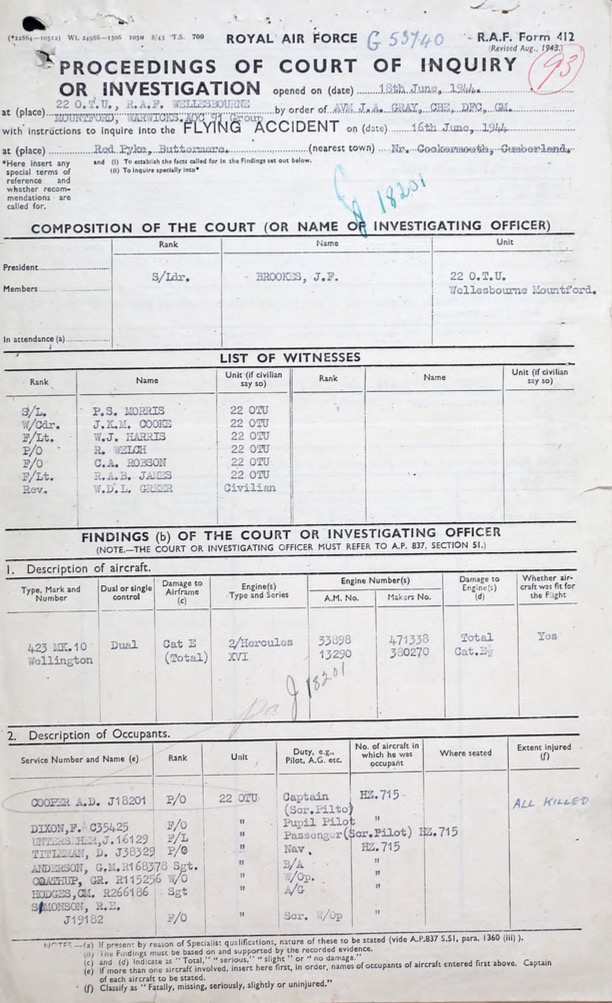
Court of Enquiry 1
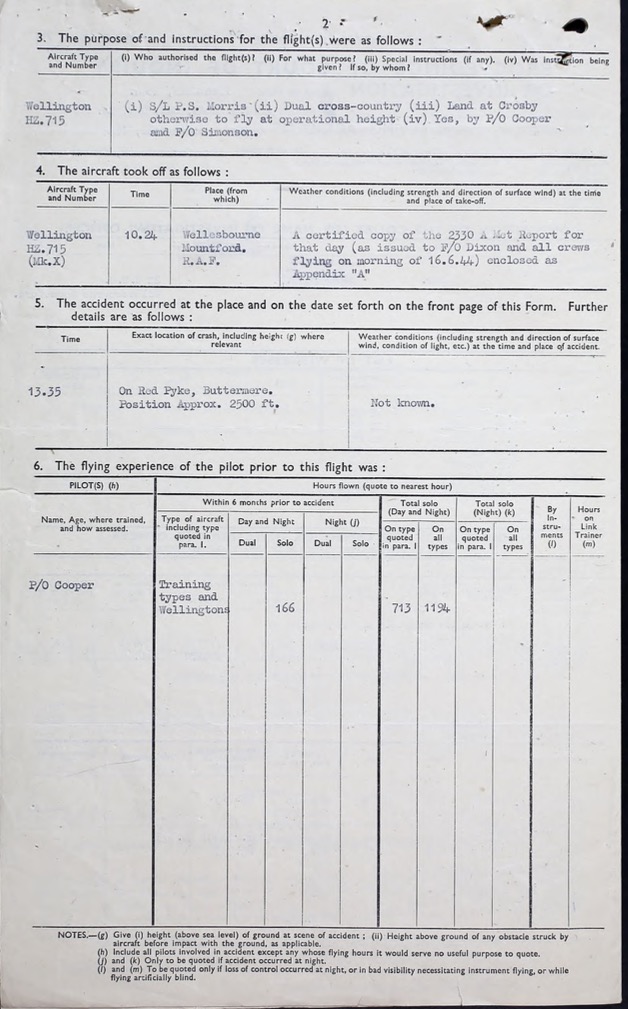
Court of Enquiry 2
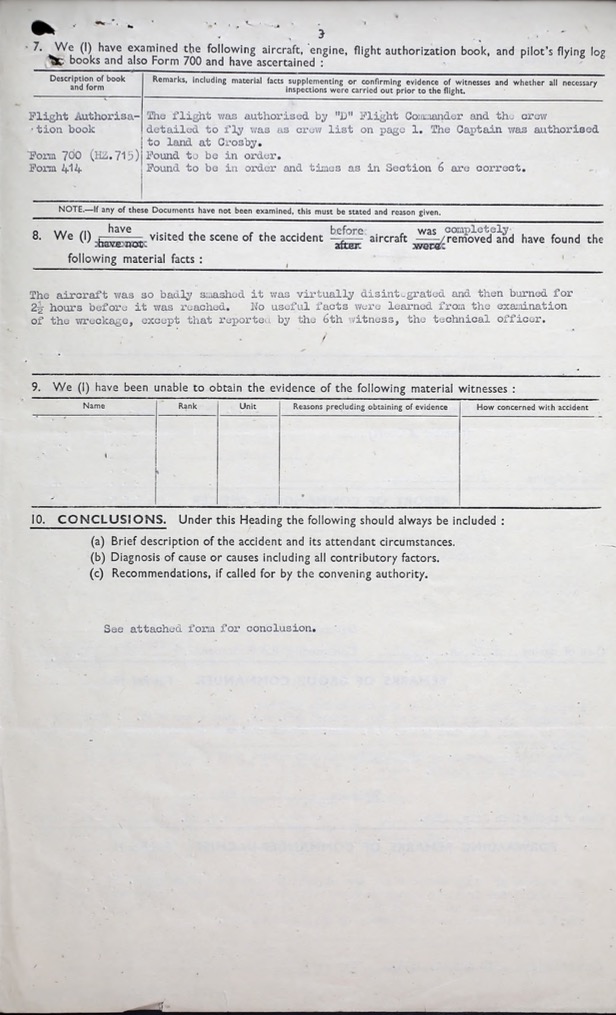
Court of Enquiry 3
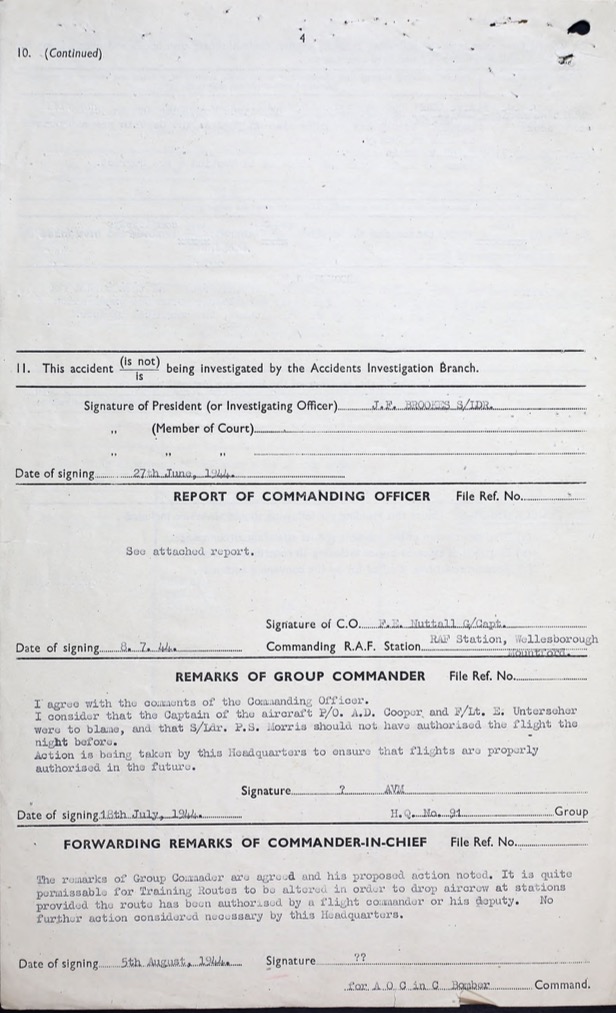
Court of Enquiry 4
Court of Enquiry 5
Court of Enquiry 6
Court of Enquiry 7
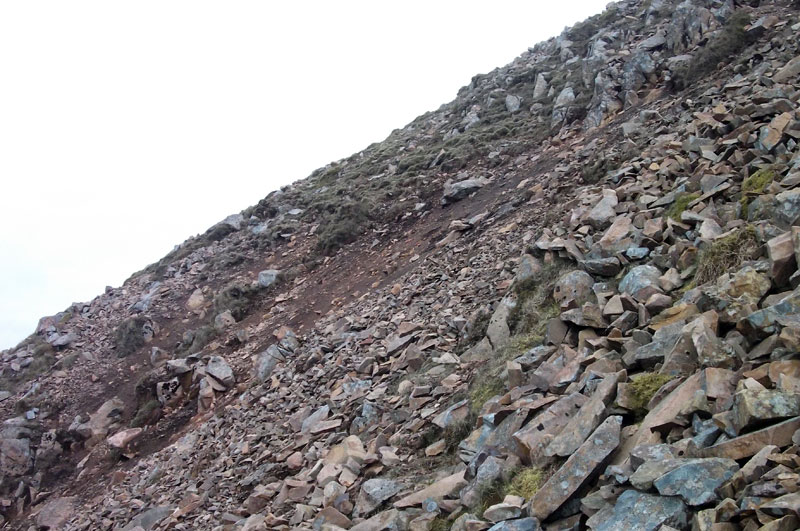
The crash location