


William Thomas's Story.
Wlliam Thomas Barnes was born in Kingscote South Australia on 9th August 1916. He lived in Launceston Tasmania and enlisted in the RAAF at Hobart on 29 August 1940. He completed a Wireless Operator Air Gunner’s course at 1 WAGS Ballarat VIC between September 1942 and March 1943 when he trained at 3BAGS ( Bombing and Gunnery School) at West Sale VIC from March 1943 before transferring to UK for active duty. In UK he was assigned to bomber training with 27 OTU
Practice Turrets at 3BAGS gunnery school in Australia
On 21 January 1944 William was killed when the Wellington Bomber serial BJ652 that he was flying in crashed on a training mission.
The Crash of BJ652
The crew of 6 Australians were flying a 3.5 hour night cross country flight from RAF Church Broughton near Derby, a satellite to No.27 OTU’s main base at Lichfield. Their route, covering nearly 500 miles, was Church Broughton – Haverhill (Suffolk) – Pocklington (East Yorkshire) – Goole (East Yorkshire) – Bury St Edmunds (Suffolk) – Melton Mowbray (Rutland) and return to Church Broughton. Originally their route was to have taken them as far north as Peebles in the Scottish borders but expected bad weather meant this leg was removed from the plan.
Initially the crew were not assigned to fly BJ652, but their primary aircraft (coded K) was declared as unserviceable due to an oil leak so they switched to BJ652. The W/T equipment that was fitted to BJ652 was also faulty and this had to be repaired before the crew could depart. This delayed their take off from a planned 17:30 until 20:17.
The flight then proceeded normally with the the first legs of the flight being recorded in the W/T log on board the aircraft. At 21:40 Lichfield transmitted a message instructing the crew to return by 23:00 as the weather front affecting Scotland was expected to arrive across northern England around 23:30. At around the same time the crew had recorded their position as 2 miles East of Gainsborough on the north bound leg to Pocklington.
At around 21:55, with the aircraft in the Goole area, the crew turned for base. Approximately 15 minutes later an aircraft that was presumed by the RAF to be BJ652 was observed by the Royal Observer Corps positions on the edge of Sheffield and at Baslow heading in a South Westerly direction at about 2,000 feet.
Shortly after this the aircraft crashed at Smerril a few miles SW of Bakewell, the aircraft had flown into a rock outcrop and was completely destroyed
The Court of Inquiry concluded that the aircraft was approximately on course and that the flight was proceeding normally with the crew regularly obtaining radio position fixes with QDMs from various stations, including one from Lichfield a minute before the crash. They were always close to on course, even at the time of the crash. The low altitude of the aircraft was put down to the pilot knowing that they were approaching the base and began to descend but may also have had a faulty altimeter. The change in air pressure that had occurred during the flight would have meant the altimeter would have over read by some 90 feet. All 6 crew members on board the aircraft were killed instantly when it crashed. They were:
Lloyd George Edmonds Flight Sergeant RAAF Pilot
Frederick Popsham Deshon Flight Sergeant RAAF Navigator
James Kydd Flight Sergeant RAAF Air Bomber
William Thomas Barnes. Flight Sergeant RAAF Wireless Operator
Keith Jobson Perrett. Flying Officer RAAF Air Gunner
Thomas Dudley Murton Sergeant RAAF Air Gunner

Memorial for BJ652 crew at Middleton

27 OTU Wellington


Crash location
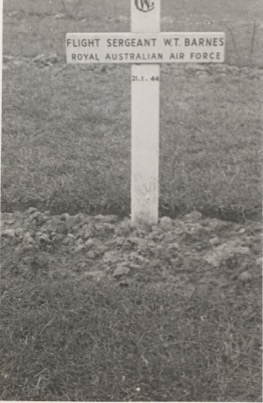
Barnes temporary grave marker at Blacon