


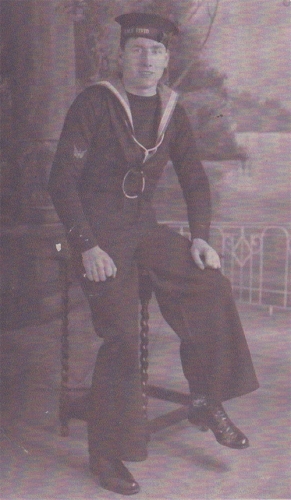
Thomas's Story.
Thomas was born in Birkenhead in 1914 the son of John and Dorothy McMann.
He was one of seven children and the younger brother of my grandmother. One of his brothers served in the Royal Air Force and another in the Merchant Navy during the Second World War. Tom was educated at St Werburghs and later at St Hughs school in Birkenhead. He left school aged 14 and was first employed at a clothiers. He later worked on the construction of the Mersey Tunnel.
In 1930 Tom fulfilled his passion by joining the Royal Navy on his 16th birthday. He trained at the land naval base HMS Ganges. During his naval career he travelled to many parts of the world including the Mediterranean, Africa, Malta, Gibraltar and South America. He later volunteered for the hazardous life of submarines.
Tom became a Leading Telegraphist and when war broke out in 1939 his boat was sent from Gibraltar to the coast of West Africa, where it was to join the South Atlantic Command for Convoy Defence Duties. He was later involved in various wartime submarine patrols including some that took him to the Falkland Islands and the North East coast of Brazil.
Tom was engaged to a friend of his sister and they had met when she had visited the family home.
In September 1940 Tom was seconded to assist on a Polish submarine – ORP ‘Wilk’. (Wolf) and was involved in patrols in the North Sea.
Later in 1940 he was home on leave and went to see a new submarine which was to be his next boat and was being prepared in Cammell Lairds Shipbuilders in Birkenhead. However Tom suddenly found himself travelling to Gosport for an unexpected journey on the submarine HMS Swordfish .It was arranged that he was to take the place of a sailor who took leave due to family illness. Although Tom had not been due to be assigned to the Swordfish he travelled to Gosport and reported for duty. The submarine left England on the 7th November 1940 from Portsmouth and was not heard of again.
HMS Swordfish sailed for patrol off the coast of Brest with a crew of 41 but failed to signal back on 15th or 16th as arranged. She was declared ‘overdue’ and ‘presumed lost’ and believed to have sunk in the Bay of Biscay either by mines or at the hands of the German destroyers near Brest. The submarine vanished with no trace and Tom and his shipmates were never to return home again. His family never knew what happened to him. He had only 3 months left to serve of his five year term of voluntary submarine service.
Almost one year after he died Tom’s mother received the news that Leading Telegraphist Thomas McMann had been awarded the ‘Krzyza Walecznych’ – the’ Polish Cross of Valour’. This medal was awarded by the Polish government, in recognition of their bravery, to an individual who has ‘demonstrated deeds of valour and courage in the fields of battle’ and is equivalent to the British Military Cross. Tom was also awarded The 1939-45 Star, The Atlantic Star, The African Star and The War Medal 1939-45.
The fate of the Swordfish was to remain a wartime mystery for almost forty three years.
In 1983 a diver was probing the sea 30 miles out from Gosport off the Isle of Wight coast looking for wrecks and discovered the submarine in about 150 feet of water. She had been broken into two pieces and had almost certainly hit a mine a few hours after leaving Portsmouth. The escape hatch was open but it seemed that none of the 41 men escaped.

HMS Swordfish
HMS Swordfish
Tom’s family were contacted and finally found out what had happened to him more than forty years earlier. They were invited to attend a service at the Swordfish’s last home - the Submarine Museum at HMS Dolphin, Gosport – while a Royal Navy submarine sailed over the area where HMS Swordfish was found and dropped a wreath in memory of all of the crew who lost their lives, as the precise location of The Swordfish was kept secret.
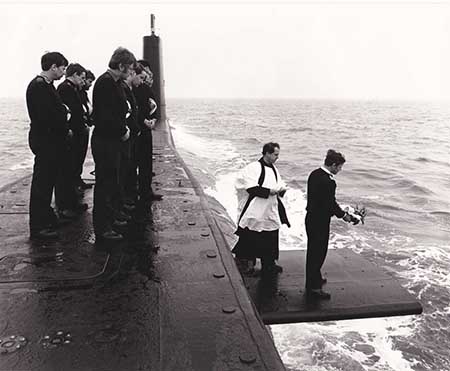
Wreath laying from a Royal Navy submarine at the site of the wreck of HMS Swordfish in November 1983.
Wreath laying from a Royal Navy submarine at the site of the wreck of HMS Swordfish in November 1983.
There has been no attempt to bring the wreck to the surface as she is still armed with 12 live torpedoes and also because the ship was promptly listed as a war grave by the Ministry of Defence
HMS Swordfish will remain Thomas McMann’s final resting place.
There are no flowers on a sailor’s grave
No lilies on an ocean wave
The only tribute is the seagull’s sweep
And a teardrop on a loved one’s cheek
No lilies on an ocean wave
The only tribute is the seagull’s sweep
And a teardrop on a loved one’s cheek
In Memory of my Great Uncle Thomas McMann - E Moran.
Research and photographs by Chris Booth