


James Henry's Story.
Sergeant James Henry Williamson died on 3rd January 1951, killed in action in Korea. He is buried in the United Nations Memorial Cemetery, Busan, South Korea. He was 35 years old, and left a widow Rose Anne Beatty, and a four year old son, Michael, born in 1946.
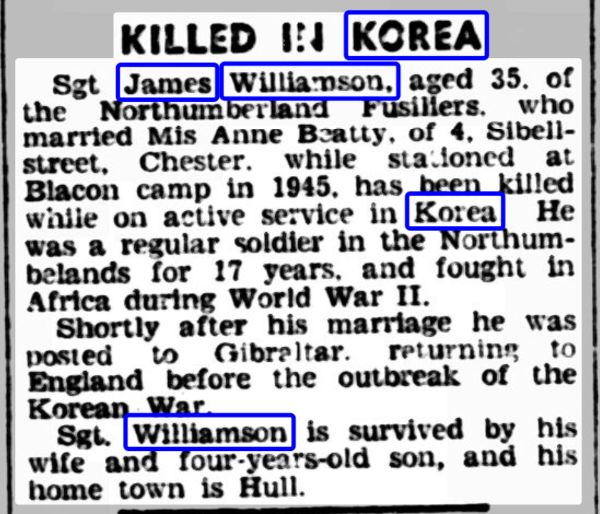
Cheshire Observer 20th January 1951
James was born on 20th May 1915, the son of James Williamson (1882 - 1946) and Arabella Hotham (1880–1928). He came from Sculcoates, Kingston upon Hull, in Yorkshire. In June 1921, when James was six years old, the family home was at 10 Glencoe Avenue, Clyde St, Hull.
On 29th December 1933, aged 18, he enlisted in The Royal Northumberland Fusiliers, regimental number 4269659. He served three tours in Egypt, Palestine, the Middle East, the Far East and Gibraltar. In the summer of 1945, he married Rose Anne Beatty (1912 - 1992), of 4 Sibell Street, Chester, while stationed at Blacon Camp, north of the city on the Welsh border. They had one son, Michael Hugh (1946 - 2017)
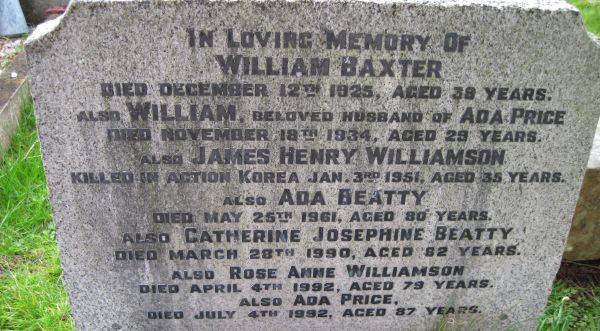
In 1950, James was sent to serve in Korea. He was killed in action at the 3rd Battle of Seoul, South Korea on 3rd January 1951, and is buried in the United Nations Memorial Cemetery, Busan. James is remembered on the headstone of a family grave on Overleigh, near Chester.
The Third Battle of Seoul was one of the most important engagements of the Korean War. The battle started on December 31st, 1950, and ended on January 7th 1951, with the Chinese capture of the capital of South Korea. The battle was part of the Chinese New Year's Offensive, a coordinated attack on the western defenses of the United Nations that intended to capture Seoul. Mao Zedong, Chairman of the People's Republic of China, believed that the United Nations (UN) could not resist another Chinese attack, and therefore planned to capture Seoul in order to place overwhelming pressure on the UN lines and force them to retreat from Korea. The UN launched a series of limited attacks to regain the lost ground, and finally recaptured Seoul in March and April of 1951 in Operation Ripper.
Find out about other soldiers from Cheshire who served in the Korean War 1950 - 1953
Cheshire Observer 20th January 1951
James was born on 20th May 1915, the son of James Williamson (1882 - 1946) and Arabella Hotham (1880–1928). He came from Sculcoates, Kingston upon Hull, in Yorkshire. In June 1921, when James was six years old, the family home was at 10 Glencoe Avenue, Clyde St, Hull.
On 29th December 1933, aged 18, he enlisted in The Royal Northumberland Fusiliers, regimental number 4269659. He served three tours in Egypt, Palestine, the Middle East, the Far East and Gibraltar. In the summer of 1945, he married Rose Anne Beatty (1912 - 1992), of 4 Sibell Street, Chester, while stationed at Blacon Camp, north of the city on the Welsh border. They had one son, Michael Hugh (1946 - 2017)
In 1950, James was sent to serve in Korea. He was killed in action at the 3rd Battle of Seoul, South Korea on 3rd January 1951, and is buried in the United Nations Memorial Cemetery, Busan. James is remembered on the headstone of a family grave on Overleigh, near Chester.
The Third Battle of Seoul was one of the most important engagements of the Korean War. The battle started on December 31st, 1950, and ended on January 7th 1951, with the Chinese capture of the capital of South Korea. The battle was part of the Chinese New Year's Offensive, a coordinated attack on the western defenses of the United Nations that intended to capture Seoul. Mao Zedong, Chairman of the People's Republic of China, believed that the United Nations (UN) could not resist another Chinese attack, and therefore planned to capture Seoul in order to place overwhelming pressure on the UN lines and force them to retreat from Korea. The UN launched a series of limited attacks to regain the lost ground, and finally recaptured Seoul in March and April of 1951 in Operation Ripper.
Find out about other soldiers from Cheshire who served in the Korean War 1950 - 1953