


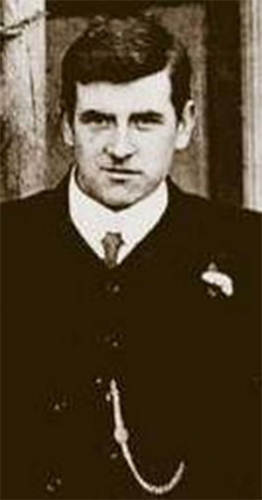
Hugh Frederick's Story.
Hugh Frederick Hayes Pte., Reg. No. 117790, Machine Gun Corps Infantry 6th Bn. (Formerly 33830 Kings Shropshire Light Infantry). Enlisted Sale and D.O.W. 27-3-18 F&F. Cemetery; Cabaret-Rouge British Cemetery Souchez. XXIV.A.7.
Hugh Frederick Hayes Birth Certificate confirms he was born on the 18th May 1888 in Acton, sub-district of Weaverham. His father, also called Hugh, was a Farm Bailiff. Mother, Annie Hayes was formerly a Royles. Cheshire BMD records Hugh Hayes and Annie Royles marriage at Northwich, a in Civil Marriage or Registrar, in the years 1881/85. Free BMD records a Hugh Hayes marrying a Annie Royles in Northwich September 1883.
The 1891 census has the family living at Cliff Cottages Acton, Hugh would be 2 years of age. The 1901 census still has Frederick Hugh Hayes living at Acton Cliff Cottages with his father Hugh (40) mother Annie (40) brothers George (15) Oswald (10) Sydney (7) and sister Florence (3). All the children and mother born in Acton, father born Crowton. Hugh, father, his occupation is recorded as joiner/carpenter. The 1911 census has Frederick Hugh Hayes (22) living and working at Herbert Jackson's Ivy Farm, The Green, Chorlton-cum-Hardy as a horseman.
Using the Manchester WW1 Memorial website you find Hugh F. Hayes remembered on the St. Anne's Church, Sale Moor, Memorial, Church Road West, Sale M33 3GD. Discussions with Sale reference library have confirmed that he is not recorded in their local paper. The reference library have had people searching the local paper to extract relevant information on WW1 lads, in this case with out any success. They did point me to the Trafford War Dead online information which confirms the census information above. They also understood from Ancestry information that he was married to a Harriet Hayes. Using FreeBMD this is confirmed with the following information, Harriet Hayes nee Langshaw at Chorlton, Sept. 1912. Completing a quick search for children on FreeBMD we find a Jane E. Hayes born in Bolton in March 1918, mothers maiden name is Langshaw., so it looks like Hugh will have had a daughter.
Through Ancestry, Will and Administration; Hugh F. Hayes Will is recorded; “Hayes Hugh Frederick of Ivy Farm Cottage Dane Road Sale Cheshire, Private in the Machine Gun Corps died on the 27th March 1918 at the Field Hospital Fechain France. Admin Chester 7th Dec. to Harriet Hayes, widow, effects £230.”
A uniform picture of Hugh was in the Manchester Evening News 19th Sept. 1918, P2/C5, nearly 6 months after Hugh had been killed.
The cemetery, Cabaret Rouge is a few miles North of Arras and the district of Fechain which is likely to have been the location of the field hospital, which would have been no more than a few medical tents. We do not know when Hugh was injured but he would not have been held long in the field hospital so his injuries leading to his death would have been recent. Reading Lyn MacDonald's book “To The Last Man Spring 1918,” the maps suggest that Hugh would have been in the First Army sector of the front and will have been part of the retreating army or part of the troops that did not get their orders or were given the orders to hold the line at all costs as the Germans started the spring offensive of 20th March.
The Medal Roll information records a Mrs H. Slack (widow) applied for the Victory and British medals on the 13th Nov. 1922 and it appears they were issued to her on the 22nd Nov. 1922 to the following address, Stone Pail Cottage, Gatley, Cheadle, Cheshire. (Freebmd records that Harriett Hayes had married a James W. Slack in 1920 in Macclesfield.)
From the Commonwealth War Graves online site; Cabaret Rouge was a small, red-bricked, red-tiled café that stood close to this site in the early days of the First World War. The café was destroyed by shellfire in March 1915 but it gave its unusual name to this sector and to a communication trench that led troops up the front-line. Commonwealth soldiers began burying their fallen comrades here in March 1916. The cemetery was used mostly by the 47th (London) Division and the Canadian Corps until August 1917 and by different fighting units until September 1918. It was greatly enlarged in the years after the war when as many as 7,000 graves were concentrated here from over 100 other cemeteries in the area. For much of the twentieth century, Cabaret Rouge served as one of a small number of ‘open cemeteries’ at which the remains of fallen servicemen newly discovered in the region were buried. Today the cemetery contains over 7,650 burials of the First World War, over half of which remain unidentified.
Research Bob Heaton
Research Bob Heaton