


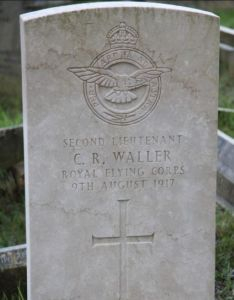
Charles Raymond's Story.
Charles Raymond Waller was a Second Lieutenant in the Royal Flying Corps. He died whilst attempting an altitude test over Hounslow in Middlesex. It seems he may have fainted when reaching 16000 feet, and lost control of his plane, which then crashed. Charles was 19 years old.

Newspaper accounts reported the findings of the inquest:

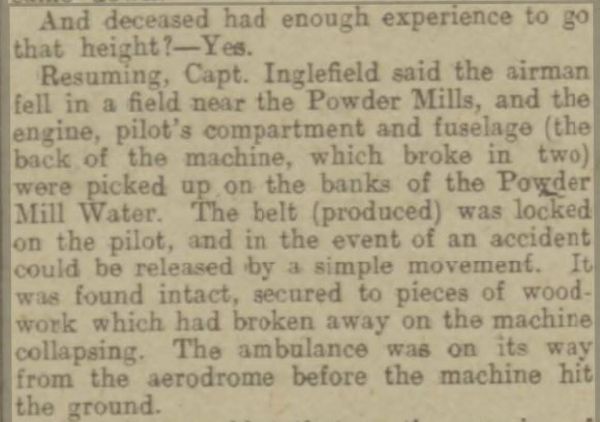
(This account in full at the bottom of this page)
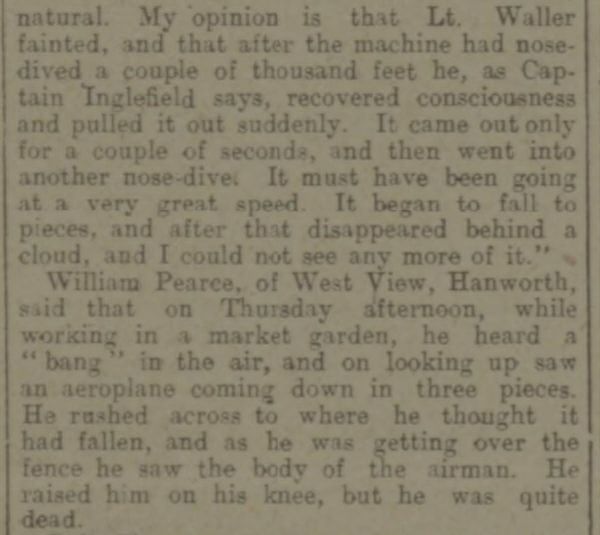
(This account in full at the bottom of this page)
Fatal Accidents.
At an inquest held on August 11th, on 2nd Lieut. C. R. Waller, who was killed at Hounslow on August 9th, it was stated that the pilot went up for an altitude test. He had never before flown more than 3,000 ft. up, but on this occasion he went up to 16,000 ft. The machine then nose-dived, righted itself, dived again, rolled over and collapsed, the pieces being scattered over a large area. It was suggested that the deceased became faint or had a heart attack. A verdict of "Accidental Death" was returned.
(Flight 16 August 1917)
FAINTED AT 16,000 FT. "Unusual" Flight of An Airman
When he had ascended to a height of 16,000 feet, Sec-Lieut. C. R. Waller, of Meopham, Kent, fainted in the air. An explosion occurred, and Lieut. Waller was killed. This was stated at the inquest at Hounslow, when the symptoms of air faintness were described.
The machine, it was stated, nose-dived, righted itself, then dived again and rolled over. When the explosion took place, the machine was blown to pieces.
Captain C. P. Inglefield said that Lieut. Waller had never before flown more than 3,000 feet up, and it was unusual and dangerous to fly 16,000 feet at a first attempt. He thought that the officer must have become faint or had a heart attack.
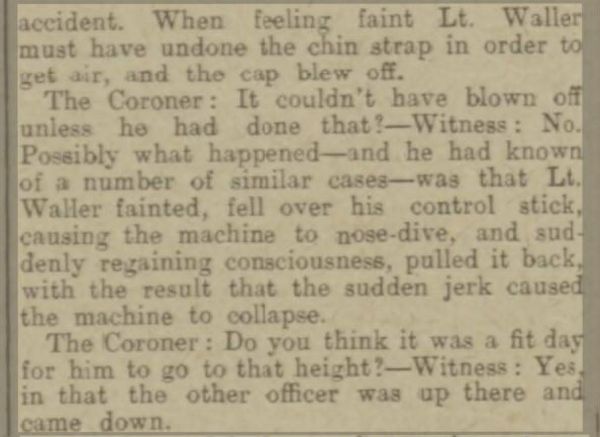
The Coroner: How can you tell that? - His flying cap was strapped under his chin before he went up, but it was found unstrapped two miles away. One of the first things a flying man does if he feels faint is to unloose the strap.
The first symptom of faintness, said Captain Inglefield, is stars moving before the eyes, when an airman should come down at once. Fainting would cause a man to fall forward and lose absolute control of the machine. It would need a strong man to fly at such a height.
A Juror: Would he know the air pressure? - No.
The Coroner: Would it not be useful to have an air pressure gauge on the machine? - It would be very useful.
The jury returned a verdict of accidental death.
(The Straits Times 29 September 1917)
What do we know about Charles?
Charles Raymond Waller was the only son of Rev Edward Harry Mansfield Waller (1871-1942) and Irene Juliana Louisa Doudney (1874-1933). (He had a brother who died in infancy in 1912) Charles was born on 19th June 1898 in Allahabad, Uttar Pradesh, India, where his father was Vice-Principal of St Paul's (C.M.S.) College.

By 1911, Charles was at a boarding school in St Leonard's, Sussex. Whilst in England, his home address was with his aunt and uncle, at Eureka Cottage, Downs Road, Meopham, Kent.
He was awarded the Rustat Scholarship (£40) for Classics for entry to Jesus College, Cambridge in October 1917 after completing his school education at Marlborough College. Instead of taking up this place straight away, he joined the Flying Corps in May 1917.
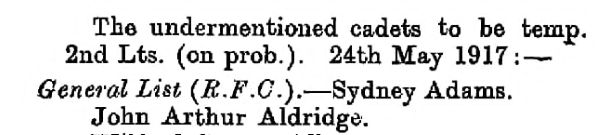

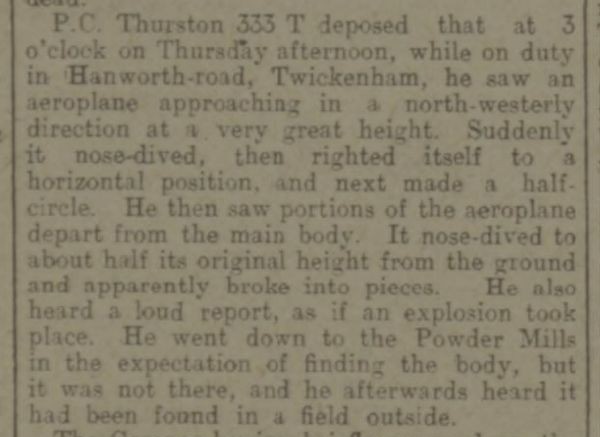
While still undergoing training, he was killed in an accident, possibly caused by fainting at a high altitude. The inquest was reported in the newspaper articles below.
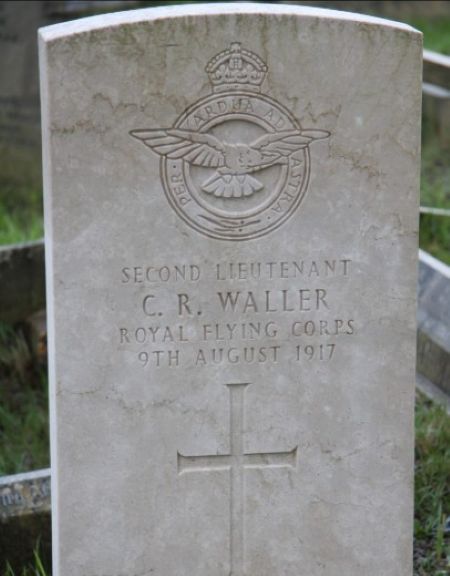
He was buried in St Leonard's Churchyard, Heston, London Borough of Hounslow, Middlesex.
The funeral cortege was headed by a firing party from the Royal Fusiliers and the band of the Depot, and following the gun carriage were two mourning coaches conveying relatives, Major Morton (commanding the Squadron) and about 40 officers of the Flying Corps, and over a hundred of other ranks. En route to Heston funeral music was played by the band, and from above came the droning of the engine of an aeroplane, which hovered around as an escort to the cortege, and which later circled above the grave during the performance of the last solemn rites.On arrival at the Churchyard the body was taken into the Parish Church of St. Leonard, where the first portion of the Burial Office was conducted by the Rev. Horace Walpole (Rector of Norwood Green),who afterwards officiated at the interment, when the customary three volleys were fired over the grave and the"Last Post"was sounded.
What do we know about Charles?
Charles Raymond Waller was the only son of Rev Edward Harry Mansfield Waller (1871-1942) and Irene Juliana Louisa Doudney (1874-1933). (He had a brother who died in infancy in 1912) Charles was born on 19th June 1898 in Allahabad, Uttar Pradesh, India, where his father was Vice-Principal of St Paul's (C.M.S.) College.
By 1911, Charles was at a boarding school in St Leonard's, Sussex. Whilst in England, his home address was with his aunt and uncle, at Eureka Cottage, Downs Road, Meopham, Kent.
He was awarded the Rustat Scholarship (£40) for Classics for entry to Jesus College, Cambridge in October 1917 after completing his school education at Marlborough College. Instead of taking up this place straight away, he joined the Flying Corps in May 1917.
While still undergoing training, he was killed in an accident, possibly caused by fainting at a high altitude. The inquest was reported in the newspaper articles below.
He was buried in St Leonard's Churchyard, Heston, London Borough of Hounslow, Middlesex.
The funeral cortege was headed by a firing party from the Royal Fusiliers and the band of the Depot, and following the gun carriage were two mourning coaches conveying relatives, Major Morton (commanding the Squadron) and about 40 officers of the Flying Corps, and over a hundred of other ranks. En route to Heston funeral music was played by the band, and from above came the droning of the engine of an aeroplane, which hovered around as an escort to the cortege, and which later circled above the grave during the performance of the last solemn rites.On arrival at the Churchyard the body was taken into the Parish Church of St. Leonard, where the first portion of the Burial Office was conducted by the Rev. Horace Walpole (Rector of Norwood Green),who afterwards officiated at the interment, when the customary three volleys were fired over the grave and the"Last Post"was sounded.
On 19th June 1920, a memorial was unveiled in Alsager to remember those who had died in WW1. Charles's name appears on the front of the memorial. His connection to Alsager is that at the time, his uncle Rev Alfred Hamilton Waller (1867 - 1924) was the vicar there.






Compiled by Shena Lewington (July 2026)
Compiled by Shena Lewington (July 2026)