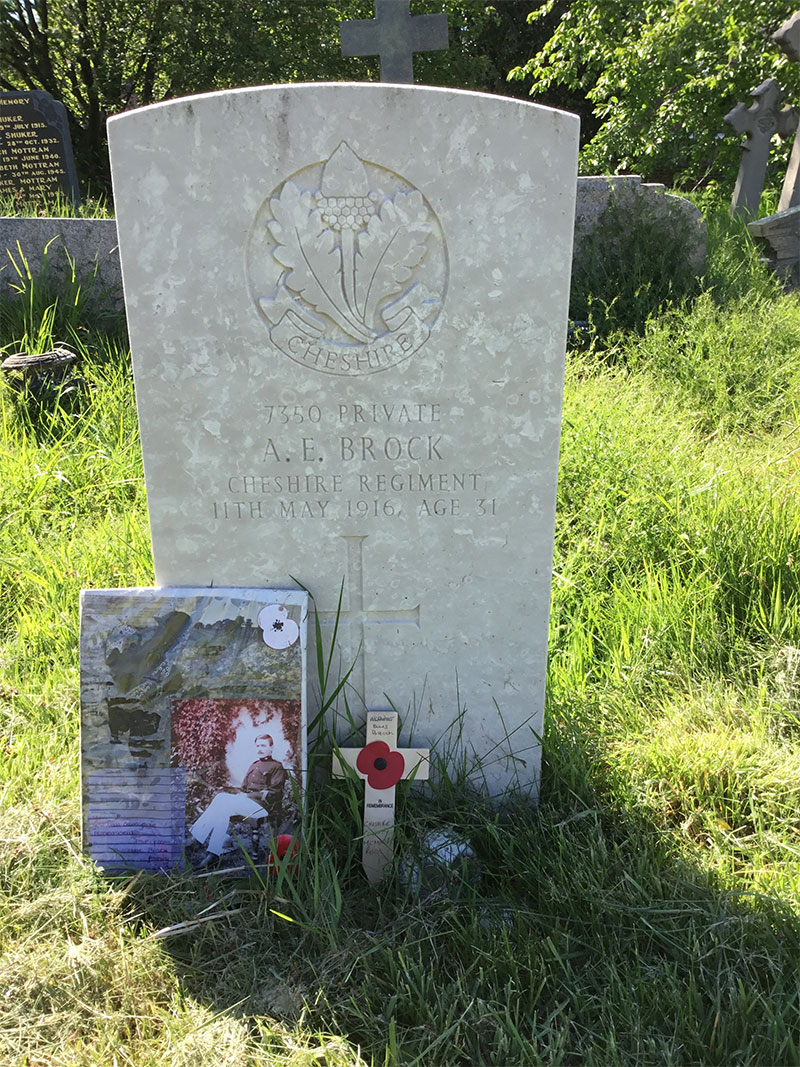
Albert Ellis's Story.
Son of Vincent Henry and Harriet Ann Brock of New Street, Crewe and husband of Maud Brock (nee Cooper) of 12, Bold Street, Haslington. They married at St. Matthew’s Church, Haslington on June 1, 1912. First enlisted on January 8, 1904. Twice served in India (1904 and 1908). Went to France (Le Havre) on August 16, 1914. Fought in the Battle of Mons where he was badly wounded in the right forearm (shrapnel wound just below the elbow joint, which shattered both the radius and ulna bones) on August 24, during the famous rearguard action by the Cheshires at Audregnies (under Captain Dugmore). He was taken prisoner, but later released due to a prisoner exchange, arriving back in England on August 25, 1915. On December 31, 1915 was discharged from the Army as unfit for further war service, due to the bad injury to his arm. He was granted a pension of 12s 6d per week, plus 1s 3d for his child. Just a few months later was found hanged under the staircase of his home after suffering from deep depression. By all accounts, following his discharge from the Army, he had been subjected to abuse for not being in uniform and this had had a detrimental affect on his mental health. His demise was discussed in Parliament (June 27, 1916) which eventually led to the introduction of the Silver War Badge, which was awarded from September 1916, to all discharged servicemen. Below is the entry from Hansard:
On his return to the UK Albert was interviewed about his experience as a prisoner of war. 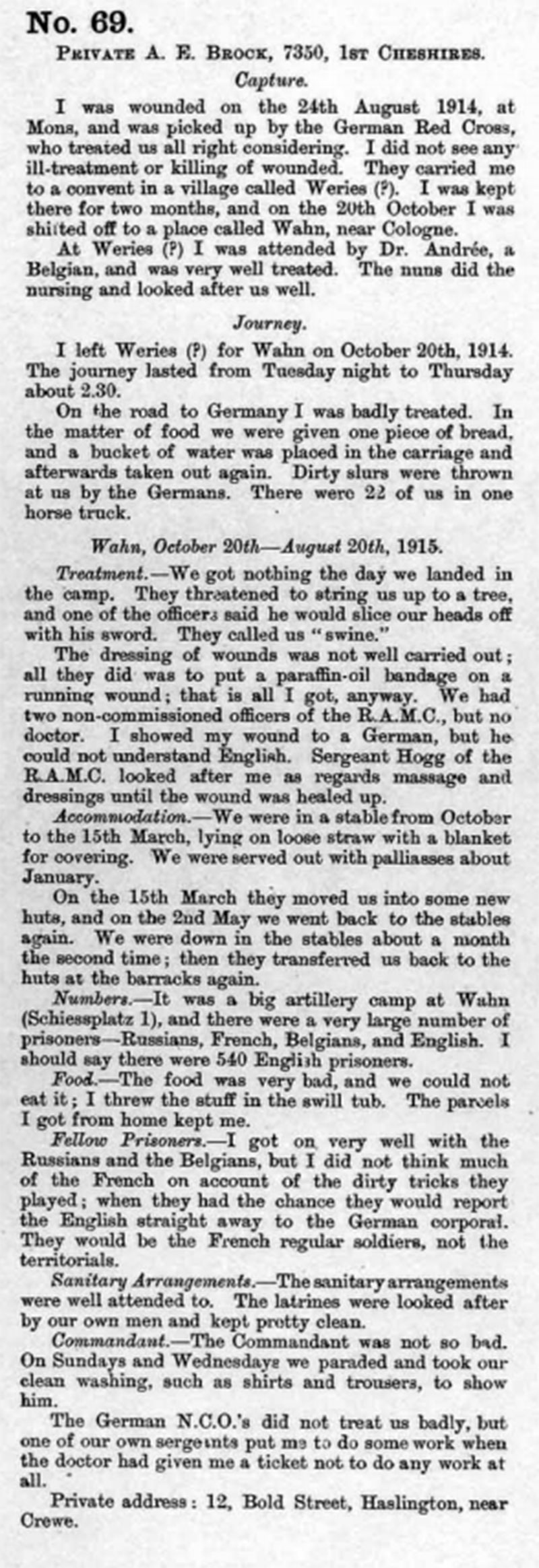
House of Commons Debate: 27 June 1916 vol 83 c703
Asked the Under-Secretary of State for War whether his attention has been called to the circumstances which caused Private Albert Ellis Brock, of the 1st Battalion Cheshire Regiment, to take his own life, consequent upon his discharge from hospital as unfit for further service and the taunts which he experienced from those who, not knowing the facts, treated him as a shirker; whether he is aware that Private Brock was badly wounded at Mons, where he was captured by the enemy, and for a year was imprisoned in Germany, where he suffered much ill-treatment by the German authorities, being afterwards exchanged; and whether, in view of these circumstances and to prevent other discharged wounded men being similarly treated, the War Office will cause a badge, armlet, or some such distinctive device to be supplied to every man who has been rendered permanently unfit for further service on their discharge from hospital which shall indicate that they have been injured in the defence of the Empire and have not escaped from service under the plea of a conscientious objection?
I am unaware of the circumstances which led to Private Brock taking his own life. He was wounded in the arm and captured in August, 1914, and was exchanged as a prisoner of war and admitted to the 3rd London General Hospital on the 25th August, 1915, and was discharged as no longer physically fit for war service in December, 1915. He was awarded a pension. It has been ascertained that, through an oversight, Private Brock did not have an armlet issued to him. Upon the general question of the issue of armlets, I would ask the hon. Member to await my reply to the next question on the Paper.