


Harry's Story.
Harry’s service papers have survived, it shows he was quick to enlist, joining the colours on the 1 September 1914, his declared age was 20 years 9 months, height of 5ft 7in, a fresh complexion with blue eyes and brown hair. It would also seem he had been in trouble, question 9 of the Attestation Paper asks, “have you ever been sentenced to imprisonment by the Civil Power”? To which his answer was, Yes Trespassing. Two weeks later, on the 15 September he was posted to the 10th Battalion Cheshire Regiment.
Life in the army seems to have been a challenge for Harry, By December 1914 the 10th battalion had moved to Bournemouth on the 3 December he was confined to barracks for 4 days for been absent at the 9 am parade, this happened again on the 16 January 1915, and then again on the 18 and 19 which cost him another 4 days confined to barracks and a day’s pay. He was to continue this trend after the battalion moved to Codford his conduct sheet shows at least another three occasions, been improperly dressed and two others absent costing him another 8 days confined to barracks, and then in July 1915 he received another 15 days confined to barracks for being absent on parade. On the 1 September 1915 while in Aldershot, he spent another 7 days confined to barracks for not complying with an order, however on the 26 September 1915 Harry and the 10th battalion embarked for France.
Their first major action was in May 1916 during the defence of the German attack on Vimy Ridge, they then moved to the Somme joining the battle just after the main attack. They made a costly attack near to Ovillers 14 - 15 July. They were also involved in the battles of Bazentin, The Battle of Pozieres, The Battle of the Ancre Heights, where the battalion successfully captured Stuff Redoubt on 9 October 1916.
In 1917, they were in action at The Battle of Messines attacking between the Wulverghem-Messines and Wulverghem-Wytschaete roads. In the Third battle of Ypres they were in action during The Battle of Pilkem. During this period Harry found himself in trouble again. On the 30 May 1917 he received 28 days Field Punishment No1. On two charges of, 1. Malingering 2. Attempting to evade duty in the front-line trenches.
Field Punishment Number 1 consisted of the convicted man being shackled in irons and secured to a fixed object, often a gun wheel or similar. He could only be fixed for up to 2 hours in 24, and not for more than 3 days in 4, or for more than 21 days in his sentence. This punishment was often known as ‘crucifixion’ and due to its humiliating nature was viewed by many soldiers as unfair.
On the 16 September 1917 he was tried by F.G.C.M on a charge of absence, the charge was “when on active service being absent without leave (on the night 3/4 Sept 1917 at the Menin Road Tunnel was absent from a working party without permission)” he pleaded Not Guilty but was found Guilty and received a sentence of 90 days Field Punishment No1. During this sentence, he was again arrested and tried on the 21 November 1917, this time the offence was stated as desertion, he again pleaded Not Guilty but was found Guilty, and this time received a suspended sentence of 15 months hard labour. However in February 1922, a letter sent to the Infantry Records requested the entry to be changed to "Absence without leave not desertion.
Harry, maybe through fear of having the sentence carried out didn’t get into trouble again. In May 1918, the battalion were near Pevy in France, on the 28 the war diary reads: 2am Enemy brought up LTM’s (Light Trench Mortars) and rifle grenades, casualties heavy. Capt. Deane killed estimate Other Ranks (O.R) casualties 200. 2nd Lt Siddons sent down to try and get artillery support.
11:30am This battalion ordered to take up a defensive flank on the right, heavy shelling casualties (estimated) 30 O.R
3pm fell back on the dry line held by the 1st Lincolns -200 yards to the rear.
7pm 1st Lincolns received orders to withdraw to the Tile Works south of La Vesle river, marched out with them.
At some point during these actions Harry was wounded and died the same day, his body wasn’t recovered and so he is named on the Soissons Memorial to the missing.
His sister Mary Ellen Littler received a war gratuity. The local press, the Northwich Guardian, mentions in November 1918 that Harry's brother Joseph Wilding died of pneumonia. 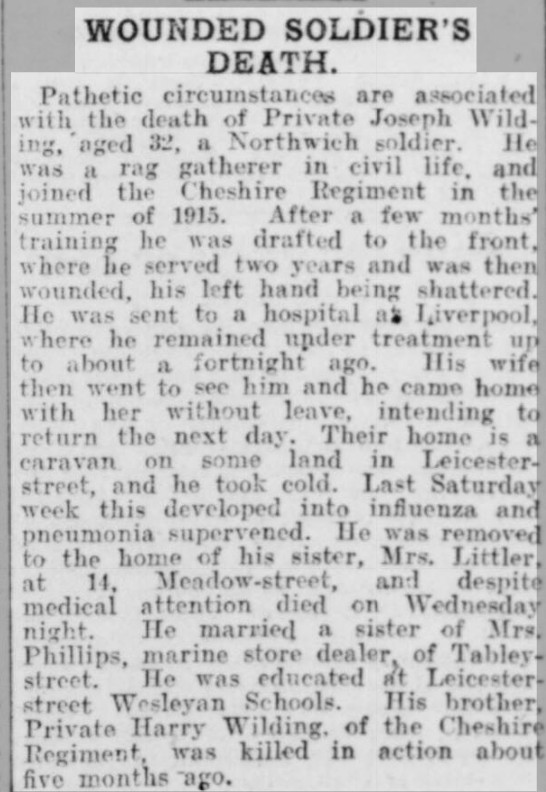
Northwich Guardian. 8 November 1918.