George Frederick's Story.
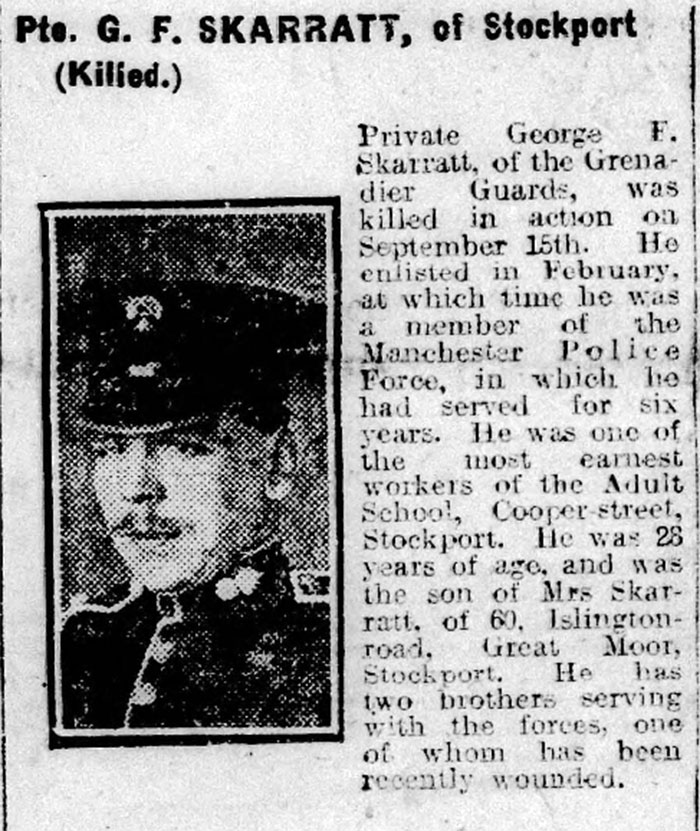
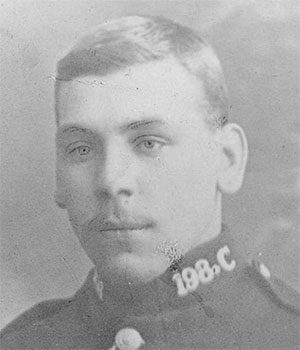
George was one of three brothers who went to War and never came home. John and William Skarratt would be killed within two months of each other, in 1918.They had been born in Manchester, but were living in Stockport at the time of the 1901 Census. John and Annie Skarratt and their eight children lived in a four roomed house at 39 Lomas Street, Edgeley. The children were Mary (then aged 20), Clara (17), John (15), George (13), William (10), Sarah (8), Gladys (6) and Lucy (5). After leaving school, George continued his education at the Adult School, Cooper Street, Stockport. He and John Skarratt were serving officers with the Manchester City Police Force. George enlisted into the army in February 1916.The Battle of the Somme had started on 1 July. The Grenadiers were not in this sector of the War at the time and did not arrive on the Somme until the end of the month. They then spent periods in the front-line trenches but had not yet been called on to go into action. This would change on 15 September when George and his mates were to take part in a major advance along a six-mile front. The role to be played by the Grenadiers was to support the leading battalions of Coldstream Guards. They would also attack from near the village of Ginchy towards the village of Lesboeufs. They left the protection of their trenches at 7.30am, following about 350 yards behind the Coldstream’s. They immediately came under heavy German shellfire - shells were reported to be dropping at the rate of one per second. They pressed on along the Ginchy-Lesboeufs road but were no longer in touch with the leading units. The Regimental History records "Almost immediately after the 2nd Battalion cleared the barrage, it came under machine gun fire from the left flank and rifle fire from the right rear. Instead of finding itself, as it expected, in rear of the Coldstream’s, it was suddenly confronted by a trench full of the enemy." They now had to deploy into line and, while they were doing so, they had many casualties and there was no artillery support. One platoon was now pushed out as a defensive flank preventing the Germans from working round behind them. This enabled troops to rush the centre of the German trench. As soon as they did so, they came under grenade attacks from Germans further down the trench system. Supplies of their own grenades were now running low and they were being forced back. Captain Harcourt-Vernon led the men in a bayonet charge across the open ground - taking the Germans by surprise. The Grenadiers were now able to hold their positions against several counter-attacks until things quietened down in the night. They had suffered 378 casualties - dead, wounded or missing. George's body was never recovered and identified. Reporting his death, the local newspaper recorded the family home as being at 60 Islington Road, Great Moor but, by the early 1920s, John Skarratt was living at 12 John Street, Warrington.