


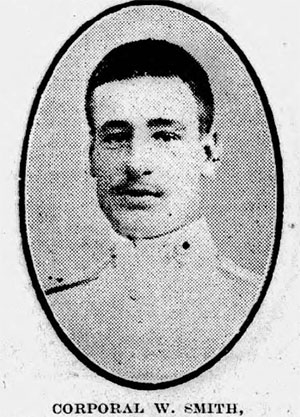
William's Story.
Little is known about William's life. Regimental records published after the War indicate he had been born in Bermondsey, Surrey but was living in Stockport when he enlisted into the army. He joined up at Liverpool and may have been working in the city at the time. He served with one of the Regiment's Regular Army battalions, and it was reported that he had served through the Boer War. His service number suggests that he possibly recalled very shortly after War was declared in August 1914 and, after brief training period, he went to France 27 October 1914. The Battle of the Somme had started on 1 July 1916. William and his battalion were held in reserve that day and only went forward during the afternoon to relieve troops who had attacked in the morning. In comparison with many other units, their casualties had been relatively light. On 9 July, the Battalion took part in its first significant engagement of the Battle. In comparison with the attacks of nearly two weeks before, this was a fairly localised advance to try to wrest the village of Ovillers from the Germans. Zero hour was fixed for 11.30am. As the men advanced, they were quickly pinned down by heavy machine gun fire. The attackers had hoped to work through the original German trench system which had been captured in previous days, but the commander of "D" Company reported that the trench leading to their objective came to a dead end and they had 100 yards of open ground to cross. A single company did not have the strength to carry out an attack in the open. Re-enforcements were sent up and the objective was taken at about 4pm. A further attack was ordered for the next day, even though the men were very tired from the previous day's fighting. The commanding officer's report on this attack noted the "advance had been carried out across craters and ground which resembled ploughed fields under considerable hostile sniping and machine gun fire, the whole was in an unimaginable mass of craters, dead and debris. It had been found best to advance with scattered parties in small rushes." It proved not to be possible to secure all the objectives due to the mounting casualties. The attacking battalions then dug in and held the positions, under heavy fire, for the remainder of the day and throughout the 11th. It must be presumed that William was killed by shellfire. His body was never recovered and identified.