


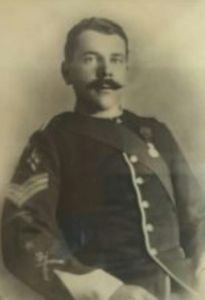
John William Thomas's Story.
Work in progress
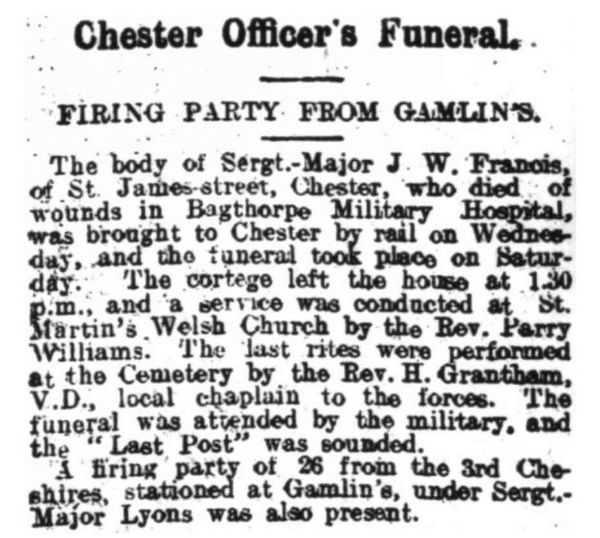
Sergeant-Major John Francis, 7724, 1st Battalion Cheshire Regiment, was shot in the head on 7th May 1915, in France. Brought back to England, he died of his wounds at Bagthorpe Military Hospital, Nottinghamshire on 25th May 1915. He was 27 years old, and left a wife and child.
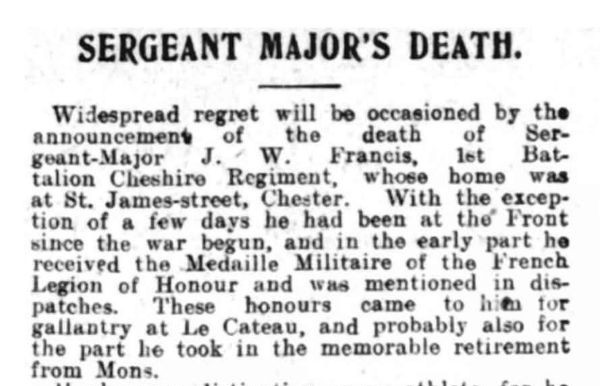
SERGEANT MAJOR'S DEATH.
"Widespread regret will be occasioned by the announcement of the death of Sergeant-Major J.W.Francis, 1st Battalion Cheshire Regiment, whose home was at St. James-street, Chester. With the exception of a few days he had been at the Front since the war began, and in the early part he received the Medaille Militaire of the French Legion of Honour and was mentioned in dispatches. These honours came to him for gallantry at Le Cateau, and probably also for the part he took in the memorable retirement from Mons.
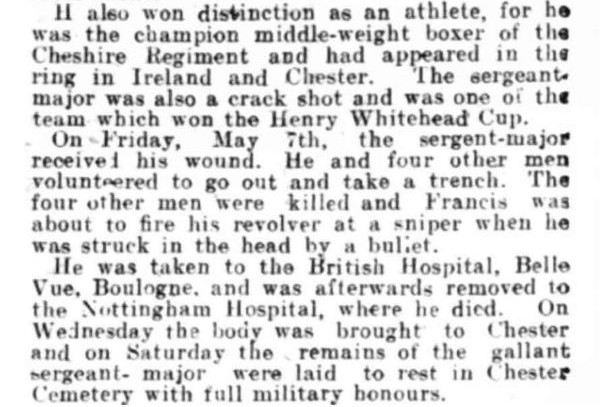
He also won distinction as an athlete, for he was the champion middle-weight boxer of the Cheshire Regiment and had appeared in the ring in Ireland and Chester. The sergeant major was also a crack shot and was one of the team which won the Henry Whitehead Cup.
On Friday, May 7th, the sergeant major received his wound. He and four other men volunteered to go out and take a trench. The four other men were killed and Francis was about to fire his revolver at a sniper when he was struck in the head by a bullet. He was taken to the British Hospital, Belle Vue, Boulogne. and was afterwards removed to the Nottingham Hospital, where he died. On Wednesday the body was brought to Chester and on Saturday the remains of the gallant sergeant-major were laid to rest in Chester Cemetery with full military honours."
(Crewe Guardian, 1st June 1915)
John William Thomas Francis was born in the autumn of 1887, the only son of William Francis (1857 - 1920 ) and Ellen Ann née Hughes (1857 - 1923). He was known to his family as "Tom". His father was a miller. He grew up in St James Street, Chester, with his four sisters - . Jane (1880–), Margaret Ellen (1883–1937), Catherine Winifred (1884–1940) and Mary Grace (1889–1966). In 1891, the family was living at number 1 St James Street, in 1901 at 22, and in 1911 at number 27. John attended Christ Church School.
In the spring of 1912, when he was 24, John married Florence (Florrie) Hanley in Belfast, Ireland. They had one son William Robert Francis (1910 - 1977). (William went on to marry Henrietta Donaldson 1911–1962) and Enid Wilcox (1909 - 1985) ). At the time of his death, John and Florrie's address was in Broughton Heath, Chester but in 1923, when William was baptised at the age of 13, Florrie's address was shown as 27 St James Street, Newtown, Chester.
Military service
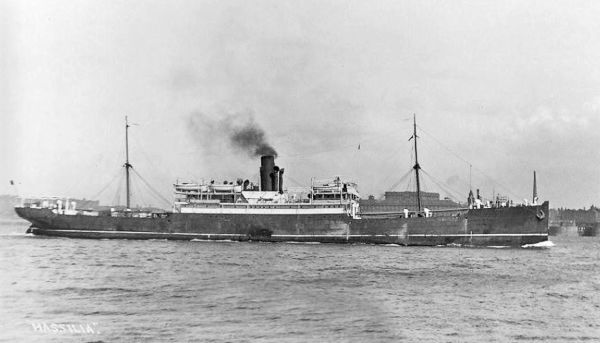
John (Tom) had joined the Bugle Band of the Earl of Chester's Volunteers, now known as the 5th Battalion of the Cheshire Regiment. He joined the County Regiment in 1904, and served in Londonderry before the start of the Great War. He sailed on the SS Massilia (below) on 14th August 1914 and his medal card confirms that he entered France at Le Havre on 16th August.
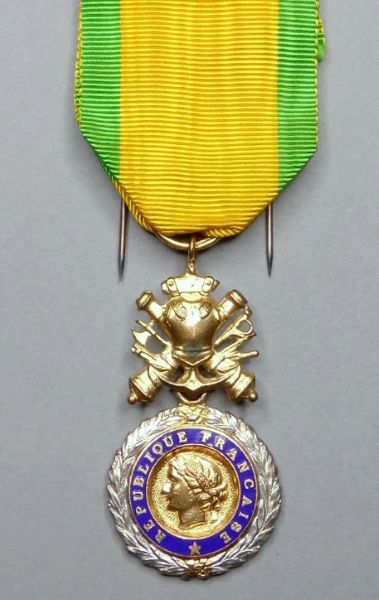
Awarded the French Military Medal
“At Le Cateau the Battalion was put in reserve, but seeing the tight corner two Regiments were in, two detachments of the Cheshires went out, the one under the late Captain Rich, the other under Company Sergt-Major J.W.T. Francis. The former held a trench on the left, and the latter a small ridge on the right, and thus held up some hundreds of the enemy, while the Bedfords and the K.O.S. Borderers retired safely between them.”
(Newspaper report, published June 1915)
For his gallantry at Le Cateau, John was awarded the Médaille militaire. The French "Military Medal") is a military decoration for other ranks for meritorious service and acts of bravery in action against an enemy force. It is the third highest award of the French Republic, after the Legion of Honour, a civil and military order, and the Order of Liberation, a Second World War-only order. The Médaille militaire is therefore the most senior entirely military active French decoration.
Mortally wounded
After being injured in the head by a sniper, John was taken to hospital in Wimereux, Boulogne, France. From there, he wrote to his father saying:
"Well, the Buffer’s got me at last – a German officer. I am shot through the brain, and well I knew about it, too, although I was operated on by the finest brain specialist, and I am going on A1. I was left paralysed down my left side after the operation, but I am getting all the use back again. Thank God I have something to be thankful to Him for. We were retaking Hill 60 at 3 a.m. I had buried 102 chaps gassed previously, in one grave, and my poor Colonel died in my arms the day before, so it is comforting to be alive.
I am quite cheery and comfortable. I am not allowed to sit up. I was the fifth victim of the sniper. Four were killed outright in front of me. I was just on the point of releasing my revolver, but he was first, worst luck. The Major said ‘I am afraid I will lose you.‘ He nearly did so. At any rate I am A1, and when I get a little nearer convalescent will probably be sent to a Chester Hospital. I remain your ever loving son, Tom."
(Chester Chronicle 5th June 1915).
After an operation to remove the bullet, John was moved back to England to Bagthorpe Military Hospital, Nottingham. There, he suffered a relapse. His wife Florrie received a telegram from the hospital to say John was dangerously ill. Florence left Chester immediately for Nottingham, but, before her arrival, her husband had passed away at 4.15pm on 25th May 1915.
Burial and commemoration
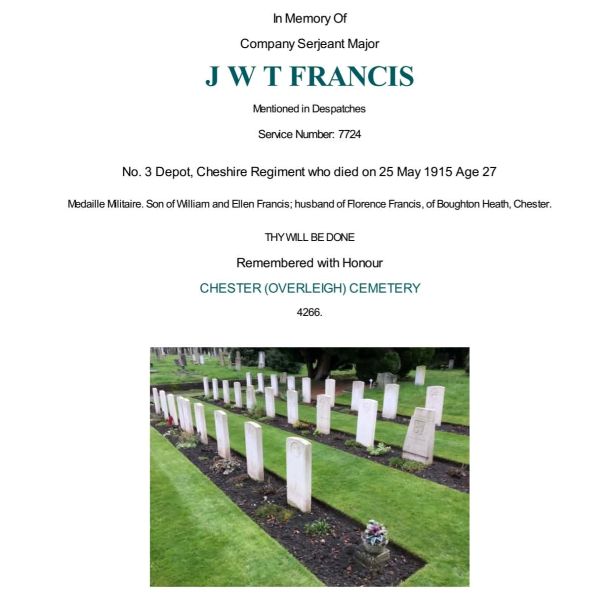
CSM John Francis was buried with full military honours on the 28th May 1915 in Overleigh New Cemetery, Chester.
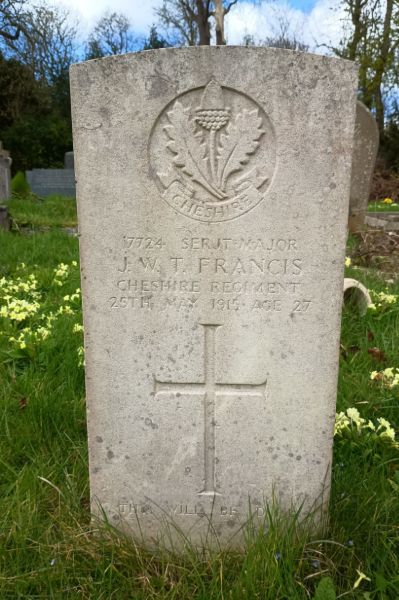
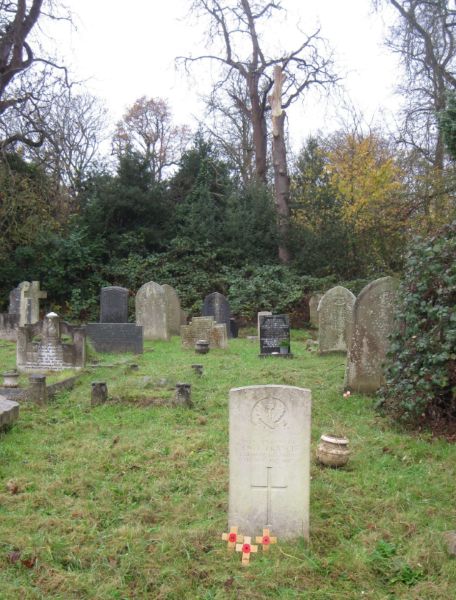
Photographs of headstone credit to Chris Kemp
Sergeant-Major Francis is remembered on a plaque inside the Church of St Mary Without The Walls, Handbridge, Chester.

Image © Linda Shuttleworth (WMR-13061)
Information compiled by Shena Lewington (November 2026) with acknowledgements to research undertaken by Chris Kemp, Graham Conway et al.
Sergeant-Major John Francis, 7724, 1st Battalion Cheshire Regiment, was shot in the head on 7th May 1915, in France. Brought back to England, he died of his wounds at Bagthorpe Military Hospital, Nottinghamshire on 25th May 1915. He was 27 years old, and left a wife and child.
SERGEANT MAJOR'S DEATH.
"Widespread regret will be occasioned by the announcement of the death of Sergeant-Major J.W.Francis, 1st Battalion Cheshire Regiment, whose home was at St. James-street, Chester. With the exception of a few days he had been at the Front since the war began, and in the early part he received the Medaille Militaire of the French Legion of Honour and was mentioned in dispatches. These honours came to him for gallantry at Le Cateau, and probably also for the part he took in the memorable retirement from Mons.
He also won distinction as an athlete, for he was the champion middle-weight boxer of the Cheshire Regiment and had appeared in the ring in Ireland and Chester. The sergeant major was also a crack shot and was one of the team which won the Henry Whitehead Cup.
On Friday, May 7th, the sergeant major received his wound. He and four other men volunteered to go out and take a trench. The four other men were killed and Francis was about to fire his revolver at a sniper when he was struck in the head by a bullet. He was taken to the British Hospital, Belle Vue, Boulogne. and was afterwards removed to the Nottingham Hospital, where he died. On Wednesday the body was brought to Chester and on Saturday the remains of the gallant sergeant-major were laid to rest in Chester Cemetery with full military honours."
(Crewe Guardian, 1st June 1915)
John William Thomas Francis was born in the autumn of 1887, the only son of William Francis (1857 - 1920 ) and Ellen Ann née Hughes (1857 - 1923). He was known to his family as "Tom". His father was a miller. He grew up in St James Street, Chester, with his four sisters - . Jane (1880–), Margaret Ellen (1883–1937), Catherine Winifred (1884–1940) and Mary Grace (1889–1966). In 1891, the family was living at number 1 St James Street, in 1901 at 22, and in 1911 at number 27. John attended Christ Church School.
In the spring of 1912, when he was 24, John married Florence (Florrie) Hanley in Belfast, Ireland. They had one son William Robert Francis (1910 - 1977). (William went on to marry Henrietta Donaldson 1911–1962) and Enid Wilcox (1909 - 1985) ). At the time of his death, John and Florrie's address was in Broughton Heath, Chester but in 1923, when William was baptised at the age of 13, Florrie's address was shown as 27 St James Street, Newtown, Chester.
Military service
John (Tom) had joined the Bugle Band of the Earl of Chester's Volunteers, now known as the 5th Battalion of the Cheshire Regiment. He joined the County Regiment in 1904, and served in Londonderry before the start of the Great War. He sailed on the SS Massilia (below) on 14th August 1914 and his medal card confirms that he entered France at Le Havre on 16th August.
Awarded the French Military Medal
“At Le Cateau the Battalion was put in reserve, but seeing the tight corner two Regiments were in, two detachments of the Cheshires went out, the one under the late Captain Rich, the other under Company Sergt-Major J.W.T. Francis. The former held a trench on the left, and the latter a small ridge on the right, and thus held up some hundreds of the enemy, while the Bedfords and the K.O.S. Borderers retired safely between them.”
(Newspaper report, published June 1915)
For his gallantry at Le Cateau, John was awarded the Médaille militaire. The French "Military Medal") is a military decoration for other ranks for meritorious service and acts of bravery in action against an enemy force. It is the third highest award of the French Republic, after the Legion of Honour, a civil and military order, and the Order of Liberation, a Second World War-only order. The Médaille militaire is therefore the most senior entirely military active French decoration.
Mortally wounded
After being injured in the head by a sniper, John was taken to hospital in Wimereux, Boulogne, France. From there, he wrote to his father saying:
"Well, the Buffer’s got me at last – a German officer. I am shot through the brain, and well I knew about it, too, although I was operated on by the finest brain specialist, and I am going on A1. I was left paralysed down my left side after the operation, but I am getting all the use back again. Thank God I have something to be thankful to Him for. We were retaking Hill 60 at 3 a.m. I had buried 102 chaps gassed previously, in one grave, and my poor Colonel died in my arms the day before, so it is comforting to be alive.
I am quite cheery and comfortable. I am not allowed to sit up. I was the fifth victim of the sniper. Four were killed outright in front of me. I was just on the point of releasing my revolver, but he was first, worst luck. The Major said ‘I am afraid I will lose you.‘ He nearly did so. At any rate I am A1, and when I get a little nearer convalescent will probably be sent to a Chester Hospital. I remain your ever loving son, Tom."
(Chester Chronicle 5th June 1915).
After an operation to remove the bullet, John was moved back to England to Bagthorpe Military Hospital, Nottingham. There, he suffered a relapse. His wife Florrie received a telegram from the hospital to say John was dangerously ill. Florence left Chester immediately for Nottingham, but, before her arrival, her husband had passed away at 4.15pm on 25th May 1915.
Burial and commemoration
CSM John Francis was buried with full military honours on the 28th May 1915 in Overleigh New Cemetery, Chester.
Photographs of headstone credit to Chris Kemp
Sergeant-Major Francis is remembered on a plaque inside the Church of St Mary Without The Walls, Handbridge, Chester.
Image © Linda Shuttleworth (WMR-13061)
Information compiled by Shena Lewington (November 2026) with acknowledgements to research undertaken by Chris Kemp, Graham Conway et al.