


John Thomas's Story.
John Thomas Cavanagh was born in Manchester, in 1876, the son of John Francis Cavanagh. His father was a Crimea War veteran, who had served there with the 49th Berkshire Regiment. John Thomas Cavanagh married Miss Mary Ann Forrester at St. Lawrences Church, Birkenhead, on 5th June 1905. The
, for overstaying leave from 1pm – 9.30pm, at Park Hall Camp, Oswestry, on 17th couple had 3 children. In 1911, the couple were living with their 3 children: Henry Francis Cavanagh (born on 17th February 1907); Catherine Ann Cavanagh (born on 26th February 1909); and Mary Ellen Cavanagh (born in 1911), at 8, St. Anne Street, Birkenhead. John Thomas Cavanagh was employed as a Dock Labourer.
On 8th November 1915, John Thomas Cavanagh attested under the Derby Scheme, at Birkenhead. At his medical he was recorded as being: 5ft 4in tall; with a fully expanded chest of 39in; and his age as being 39 years 1 month. His home address at the time of his attestation was 12, St. Anne Street, Birkenhead. On completion of his medical, John Thomas Cavanagh was posted to the 3rd/4th (Reserve) Bn Cheshire Regiment (No.3945). He was awarded 7 day’s confined to barracks and the loss of 1 day’s pay on 19th May 1916May 1916. On 6th July 1916, he was awarded 7 day’s confined to barracks and a loss of 3 day’s pay, for being absent without leave from 1pm 3rd July 1916 – 1pm 5th July 1916, at Park Hall Camp, Oswestry. Private Cavanagh embarked for France on 20th September 1916 and disembarked on 21st September 1916. The he was sent to a Base Depot, prior to being transferred to the 6th Bn King’s Shropshire Light Infantry on 28th September 1916 and given the new regimental number 26458. On 28th October 1916, he was sent to hospital, and on 9th November 1916, he was admitted to the 1st New Zealand Stationary Hospital with Tonsilitis. This was followed by admittance to the 12th General Hospital the following day. Private Cavanagh was sent to No.4 Infantry Base Depot after he had recovered, on 23rd November 1916, and re-joined his battalion on 8th December 1916. He was taken ill with myalgia (later diagnosed with Trench Fever) on 28th December 1916, and invalided back to England on board the Hospital Ship “Carisbrook Castle”, on 19th January 1917, and eventually posted back to his Depot. Private Cavanagh was admitted to Edinburgh War Hospital with Trench Fever, from 19th January 1917 – 20th February 1917, and from 21st February 1917 – 22nd May 1917, he was admitted to the Woodcote Park Convalescence Hospital, Epsom. On 1st June 1917, Private Cavanagh was transferred to the 3rd (Reserve) Bn King’s Shropshire Light Infantry, and on the following day was charged with “Overstaying his pass from tattoo til 7.05 pm 31st May 1917, at Pembroke Dock”, and was awarded 2 day’s confined to barracks, and a forfeit of 2 day’s pay. On 7th August 1917, Private Cavanagh embarked for France, at Southampton, and disembarked at Rouen, on 8th August 1917. He was then transferred to the 5th Bn King’s Shropshire Light Infantry on the same day, but was again transferred to the 39th Prisoner of War Company Permenant Base on 23rd August 1917. Private Cavanagh was transferred to the 867th Area Employment Company, Labour Corps (No.405704), on 24th October 1917, and on 6th November 1917, was granted Proficiency Pay Class 2. From 15th April 1918 – 11th August 1918, he was attached to the Railway Operating Division, Caneples, and from 27th August 1918 0 10th September 1918, he was granted leave back to England, leaving France via Boulogne. He rejoined his unit on 11th September 1918, and 2 day’s later was admitted the 41st Stationary Hospital (no reason given). , Birgles Amiens, and on 16th October 1918, Private Cavanagh was admitted to No.5 General Hospital, Rouen. He died of bronchial pneumonia on 10th November 1918, and was buried in Plot 5, Row 3, Grave 21, St. Sever Cemetery.
Private Cavanagh’s medal entitlement consisted of Memorial Plaque, British War Medal, and Victory Medal.
His widow received the following personal effects from her husband’s belongings: 1x wallet; letter’s; photograph’s; 1x card; religious tokens; 1x pocketknife; and 1x Dorathy Bag; which were received by his widow on 28th April 1919. She later lived at 19, St. Anne Street, Birkenhead.
Private Cavanagh was discharged to his unit on 27th September 1918, only to be re-admitted to the 61st Stationary Hospital on 10th October 1918. The following day saw him admitted to the 41st Stationary Hospital.
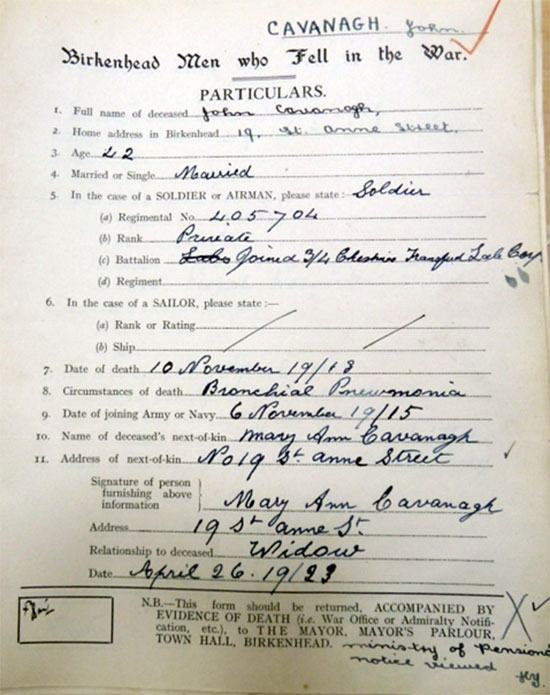
Family application form requesting John Thomas to be added to the Birkenhead War Memorial.
Researched and compiled by Peter Threlfall.
Family application form requesting John Thomas to be added to the Birkenhead War Memorial.
Researched and compiled by Peter Threlfall.
Birkenhead News 07 December 1918
BIRKENHEAD SOLDIER DIES OF PNEUMONIA.
Mrs. Cavanagh, who resides at 19, St Anne Street, has received the official communication of her husband’s death in hospital. Joining the colours in November 1915, Pte J T Cavanagh was shortly after despatched to France with the 4th Cheshires. There for three years he experienced the hard work and turmoil of war. In November of this year, he unfortunately developed broncho-pneumonia, and ultimately died in the 5th General Hospital at Rouen. Pte. J. T. Cavanagh was educated at St. Laurence’s school. Prior to enlisting was a labourer in the employ of the Clan Line.
John Thomas Cavanagh’s photograph and newspaper article by Chris Booth